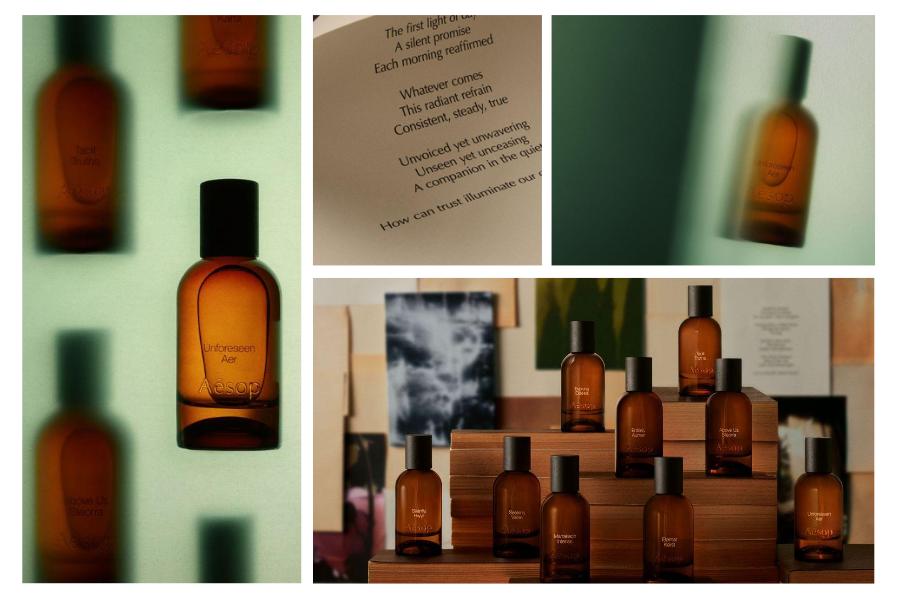
Our morning spritz of perfume – applied hurriedly with one foot out the door – rarely prompts much thought, let alone triggers a panoply of literary self-reflection. These days, we all claim to value slowing down, embracing dedicated morning rituals and relentless reminders to be more mindful. Yet weaving genuine self-reflection into an overflowing day remains elusive.
Aesop seems to have found the answer. They’ve taken a daily habit, one as personal as fragrance, and introduced it to the intellectual world of the bibliophile. By way of thought-provoking narratives and profound philosophical questions, scent becomes the invisible gateway to deeper self-inquiry.
The Moral Tale in a Bottle
The origin of this ethos goes back two decades when Aesop launched Marrakech, its inaugural personal fragrance: an aromatic interpretation of the Moroccan city beneath the Atlas Mountains. That single bottle catalyzed an expansion into a collection of twelve Eaux de Parfum, which were all tethered to the same initial premise: fragrance should mean something, not just smell good.
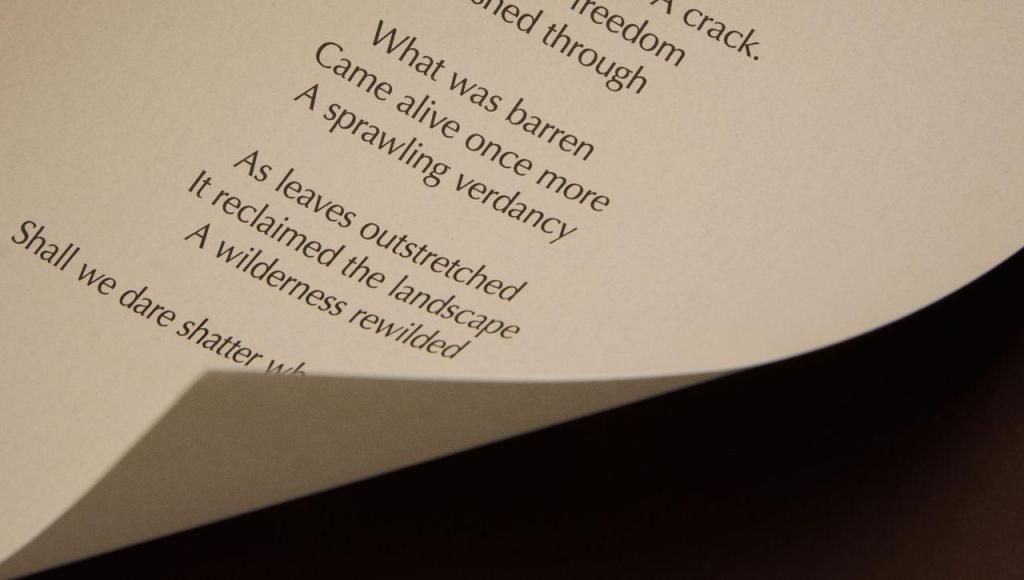
This September, Aesop has decided to make that premise explicit. Twenty years later, they commemorate this milestone by turning toward reimagination: honing their 12-fragrance portfolio and recasting it as Fragrant Fables. Drawing from the company’s namesake, the ancient Greek fabulist, the current fragrances now come wrapped in a fable-like poem printed on the box, each concerned with a particular human value, and accompanied by one unadorned question. How can trust illuminate our connections? What lies beyond surface reflections? How can change enrich us?
A perfume bottle becomes, in other words, a very small moral tale.
The Power of Olfactory Suggestion
Each fragrance is now organised around two elements: the Radical Ingredient and the Fabulist Accord.
The radical ingredient is tangible. Rose. Basil. Sandalwood. Tomato leaf. Nutmeg. It is an appropriate foundation for a scent; after all, a perfume must smell of something.
The Fabulist Accord is less literal. Something unscented in nature is given an imagined aroma through three chosen ingredients, composed not with the purpose of replicating an existing smell, but to suggest what it might be.
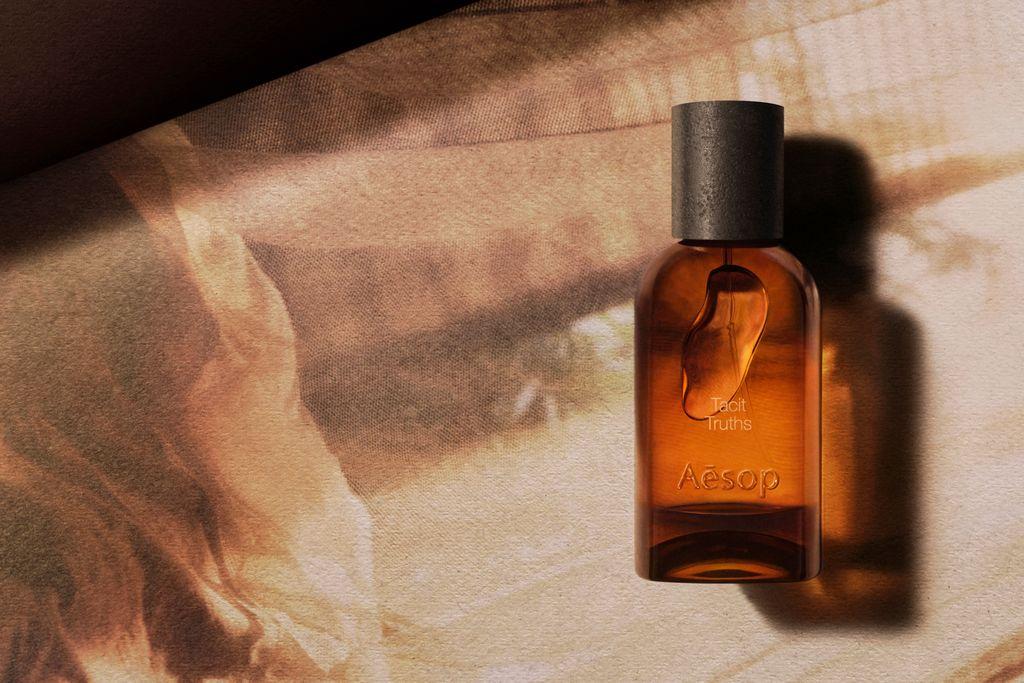
In Tacit Truths, for instance, the culmination of yuzu accord, vetiver, and fennel becomes what Aesop calls “First Light”. Basil supplies the Radical Ingredient, and the accompanying fable considers trust: the reliability of dawn, arriving each morning without announcement.
In Evoking Eidesis, neroli, petitgrain, and black pepper become “Mirror” set against sandalwood and coupled with a story about authenticity and what may exist beyond the surface.
In reality, none of us really know what “first light” or a “mirror” smells like. We may nevertheless believe that they smell of yuzu and black pepper.
This is the conceit on which Fragrant Fables depends, and it says something about perfume itself. Smell is entirely susceptible to suggestion. Tell someone that a fragrance evokes a forest and the cedar note becomes a tree. Tell them it’s an old church and the same wood becomes a pew. In Aesop’s hands, fragrance becomes a kind of sensory parable: the material never changes, but they tell you the story by which to interpret it.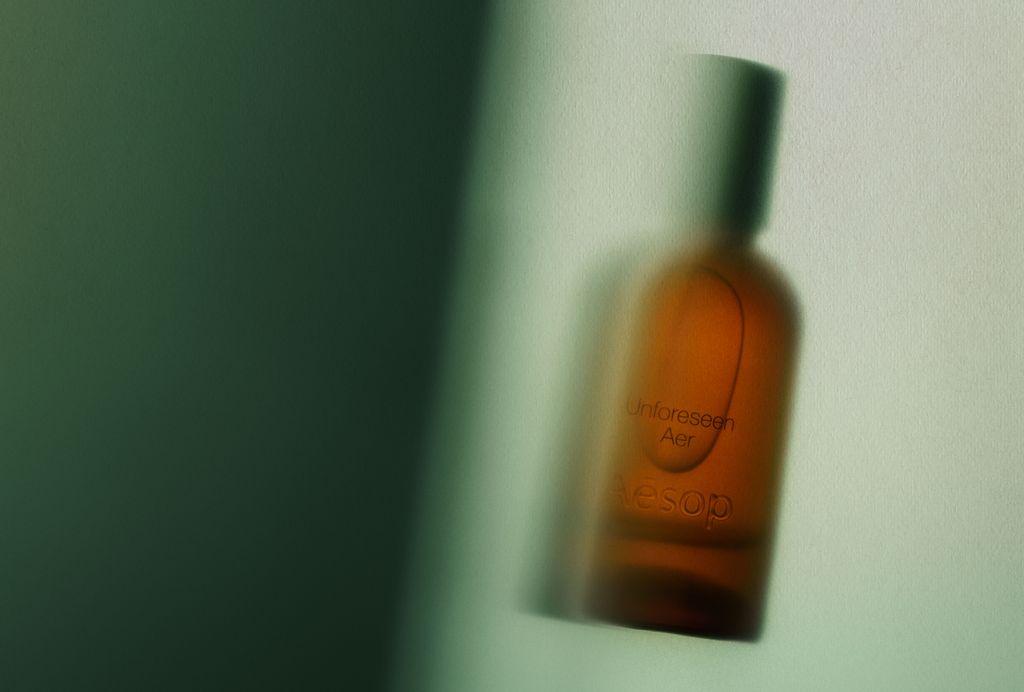
The New Eau de Parfum, Unforeseen Aer
Nowhere is this framing clearer than in Aesop’s newest Eau de Parfum, Unforeseen Aer.
Air, of course, has no perfume, but Aesop asks us to reconsider this. Its Fabulist Accord, Pure Air, a trinity of Geranium, Lavandin and Rosemary, creates a crisp, clean scent that is foiled by the textured warmth of its Radical Ingredient, Nutmeg. Olfactively, Unforeseen Aer is a departure from the conventional fougère: an intentional contrast that brings air closer to earth.
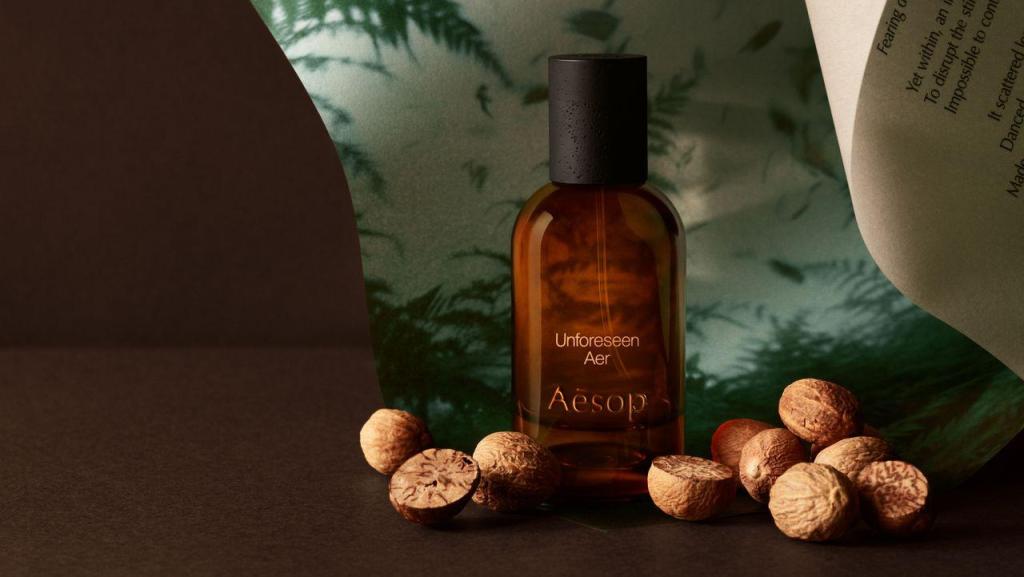
Aesop situates this imagined air across rugged heights, giving the fragrance a landscape as much as a scent. The question on the box, “How can change enrich us?”, reflects Aesop’s approach to the collection—a theme elaborated on by its accompanying fable, where air appears as a timid wind, afraid of disturbing the stillness around it. Eventually, restraint gives way to instinct as leaves scatter, branches move, and the wind makes its own form of music. Quickly, the disorder the wind once feared becomes the very thing that gives the landscape life.
It is a neat proposition for a fragrance about imperfection, and perhaps an equally neat proposition for Fragrant Fables itself. By rewriting the context around twelve familiar scents, Aesop proves a larger point: change how we frame the familiar, and we may change what we find within it.

Tactile Vessels and Evolved Names
Beyond Unforeseen Aer, this conceptual framework redefines the remaining portfolio into individual moral fables, pairing distinct botanical bases with imagined accords to interrogate specific human values. In Eternal Karst, juniper stands firm as Sea Foam patiently carves away at an ancient landscape—a meditation on resilience and what remains as time reshapes us. Rōzu Arises finds growth in a rose stripped back by winter until only its thorns remain, while Silently, Hwyl retreats beneath the canopy of a Hinoki Forest, where frankincense and the sounds of the undergrowth offer respite from everyday noise.
Journey to Ouranon turns labdanum and Ash towards reinvention; Seeking Virēre gathers cypress and Warm Tea around the quiet repercussions of kindness; and Entirely Aurner sets magnolia leaf against Silver Ore in a celebration of boldness and defiance of convention. In Boundless Erémia, tomato leaf pushes through Cracked Concrete in pursuit of freedom, while Above Us, Steorra sends cardamom blazing through Amber in an exploration of chance. Tacit Truths finds trust in the dependable arrival of First Light; Evoking Eidesis looks beyond a sandalwood-framed Mirror towards the authentic self; and, finally, Marrakech Intense returns to where Aesop’s fragrance story began, pairing jasmine with the restless labyrinth of its namesake city to ask where curiosity might lead us.
To house these revised stories, the bottle has undergone a slight transformation, too. It is noticeably taller, with a domed base, metallic lettering, and an embossed insignia. The cap takes inspiration from basalt rock, while the unscrewing atomizer addresses modern sustainability.
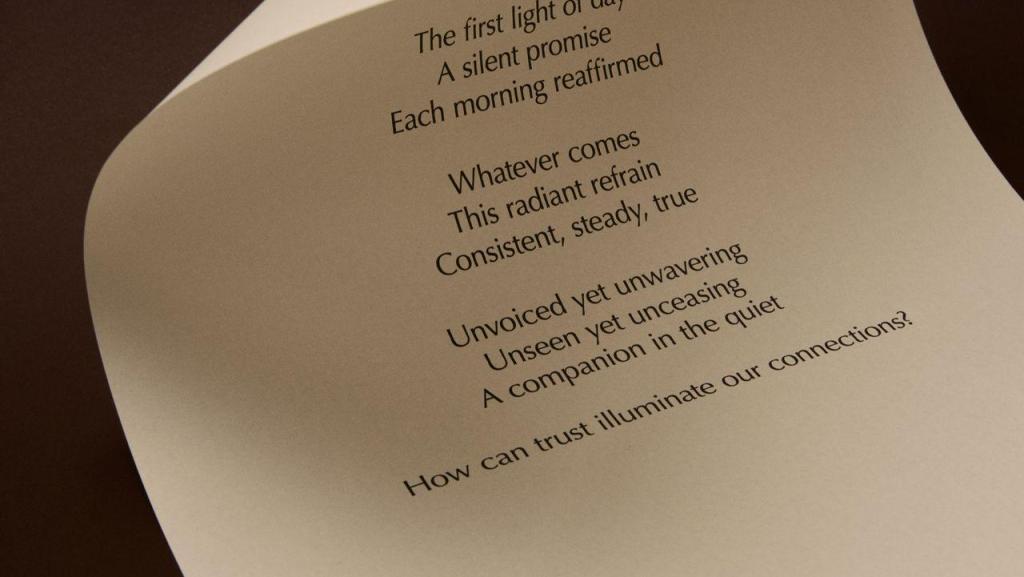
The new bottle may be more tactile, but the greater shift is not in the ornaments. A poem now envelops each box. A story sits behind each scent. And a question is left for you to answer. None alters the content of the glass, but each changes the terms on which we encounter it.

Turning Attention Inward
Fragrance is an accessory that speaks directly to identity, yet it easily becomes an automatic act of routine. While we are accustomed to choosing a scent based on how we want to be perceived, Aesop presents us with the chance to turn that attention inward. They give the gesture a second layer: it is no longer just the finishing touch to an outfit or our lasting trace when we leave a room, but something closer to a companion to thought—an object we can return to differently depending on the day, mood, or the question printed beside it.
Discover more at Aesop
View this post on Instagram
All images courtesy of Aesop.