
Escaping the Chaos for the Anti-Cyclades
After a very busy six months navigating the pandemonium and chaos of life in London, I was in desperate need of an escape; somewhere peaceful, surrounded by nature, and no more than six hours from the UK. Faced with a plethora of options, one destination stood out above the rest: Melanopetra Boutique Apartments on the volcanic Greek island of Nisyros.
For me, the Greek islands have always been the ultimate summer escape. Whether it’s spending long afternoons on beaches lapped by crystal-clear water, sailing between secluded coves with friends, or discovering vibrant nightlife after sunset, they never disappoint. This trip, however, had a different purpose. I wasn’t searching for beach clubs or packed itineraries. I wanted complete tranquillity – a destination detached from the pace of city life, immersed in nature, and authentically Greek, away from the mass tourism of the Cyclades. Nisyros delivered all three in abundance.
Reaching the island was surprisingly effortless. After landing in Kos, it was a short transfer to the nearby port before boarding a ferry that arrived in Mandraki, Nisyros, in about an hour. Finding the island was easy; choosing where to stay required a little more thought. I wanted somewhere secluded enough to feel like a true escape, yet close enough to explore the island without feeling completely cut off.
That’s when I discovered Melanopetra Boutique Apartments.
Architecture of the Landscape: Inside Melanopetra
Perched on a hillside in the beautifully preserved village of Emporio, around 400 metres above Nisyros’ volcanic caldera, the boutique property occupies a lovingly restored 19th-century stone house that immediately feels part of the island’s landscape. Much of the village was devastated by the 1933 earthquake, yet it remains one of the island’s most atmospheric settlements, its narrow alleyways and stone-built houses seemingly frozen in time.
What makes Melanopetra particularly memorable is that it doesn’t only occupy the landscape; it celebrates it. Designed and restored by architect and owner Anna Apostolou in 2015, the project was guided by a desire to preserve traditional Nisyrian architecture while creating a refined retreat built almost entirely using eco-friendly, local materials. Even its name, meaning ‘black stone’, pays homage to the volcanic rock that has shaped both the building and the island itself.
Rather than feeling like a conventional boutique villa, Melanopetra feels like an extension of Nisyros. Every architectural decision reflects the island’s character. Whitewashed minimalist interiors soften the rugged volcanic stone walls, while gentle curves, earthy tones, linen fabrics and preserved original features create spaces that feel effortlessly calm. Modern comforts are introduced with remarkable restraint, allowing the history of the building to remain the focal point.
I stayed in the 60-square-metre apartment downstairs, which is accessed directly from the village street via a few stone steps. From the moment I stepped inside, it was clear that this wasn’t a space designed simply to look beautiful in photographs. It had been carefully curated around the character of the original house, with every corner revealing another detail of its history.

Sculpted by Time: A Modern Restoration That Honours the Past
The apartment has an open-plan sitting and sleeping area, with a low arch subtly separating it from the secondary spaces. Rather than dividing the room with walls, the architecture creates a natural sense of distinction while maintaining the feeling of openness. The double bed sits on a slightly raised level beside the fireplace, giving the sleeping area an intimate, almost cocoon-like quality. Opposite it, a generous built-in corner sofa provides a comfortable place to read, relax or simply take in the stillness, while also offering sleeping space for an additional guest.
The kitchen continues the same understated approach. Fully equipped and integrated into warm wooden cabinetry, it feels contemporary without appearing out of place. At its centre is the dining area, where an original wood-fired oven has been preserved within the structure of the house. It is precisely these details that give the apartment its character: rather than erasing the marks of the past in favour of polished modernity, the restoration allows them to remain visible and become part of everyday life.
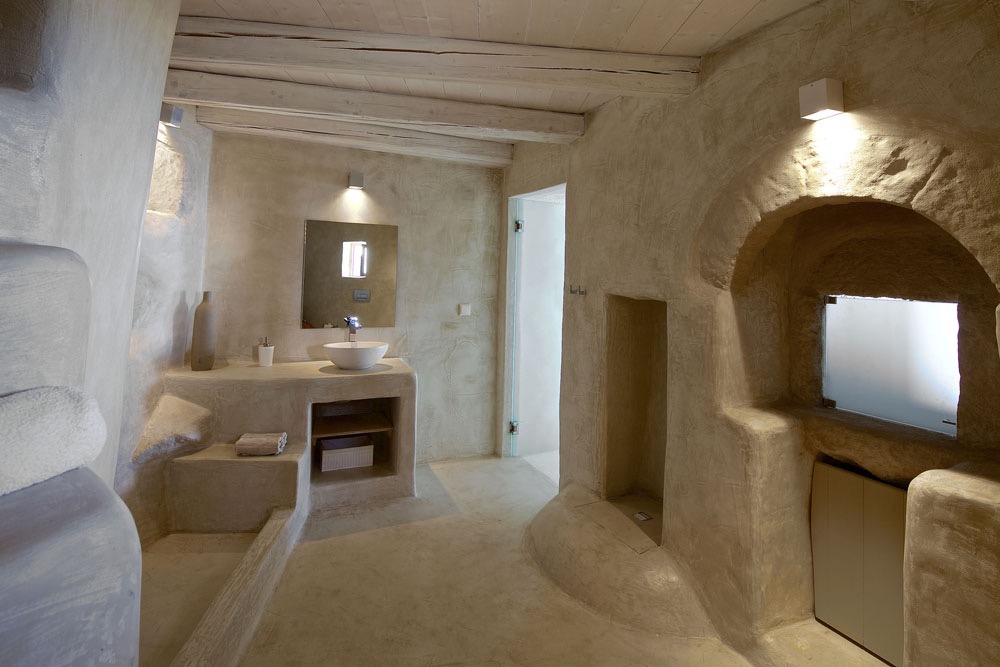
The bathroom was perhaps the apartment’s most unexpected highlight. Spacious and almost sculptural in its design, it occupies what was originally a semi-sheltered space beneath the courtyard. The original stone staircase connecting the two levels has been preserved, while traces of the building’s former life remain visible throughout. You can still see the cavities of the old oven where wood and food were once inserted, as well as the opening to the underground cistern that collects rainwater during the winter.
There was something particularly magical about this. Standing in the bathroom, I could actually hear the rainwater running through the cistern beneath the house – an almost imperceptible sound, but one that made the history of the building feel remarkably tangible. Contemporary elements, including built-in shelving, polished cement, travertine sinks and pared-back stainless-steel fixtures, sit alongside these original features without competing with them. The result is a bathroom that feels less like a conventional hotel bathroom and more like an architectural experience in its own right.

Sunlight, Silence, and the Aegean: A Mediterranean Sanctuary in Stone
One of my favourite moments each morning was waking to sunlight pouring through the small traditional windows, gradually illuminating the textured white walls and filling the apartment with a warm golden glow. The effect was almost meditative, emphasising the simplicity that defines the entire property. There is very little there that felt unnecessary, and that restraint made the space feel all the more peaceful.
Outside, the apartment continues almost seamlessly into its surroundings. Rather than being treated as a separate terrace or landscaped garden, the outdoor space feels like a natural continuation of the interior and an integral part of the stone-built environment. Laid out across different levels, it incorporates built-in seating and a dining area shaded by an enormous almond tree, creating the perfect setting for long, unhurried breakfasts or evenings spent with a glass of wine as the temperature begins to fall.
The planting is equally understated. Beds of aloe, lavender and thyme soften the stone and blur the boundaries between the property and the landscape beyond. Their scents mingle with the dry summer air, while the elevated position opens up breathtaking views across the Aegean Sea. Sitting beneath the almond tree, surrounded by the scent of herbs and the sound of little more than the breeze, it was remarkably easy to forget that London existed at all.
Upon arriving, I distinctly remember being captivated by the expansive views. The landscape stretches from the rugged volcanic hillsides towards the Aegean, with the tiny volcanic islet of Gyali visible in the distance. The balcony and outdoor spaces quickly became my favourite places to enjoy a slow breakfast or sit in complete silence, appreciating just how untouched this corner of Greece feels.

Redefining Luxury on Volcanic Time
There’s an undeniable sense of harmony throughout Melanopetra. Its thick stone walls naturally regulate the temperature, creating cool interiors during the height of summer, while fireplaces and traditional construction make it equally suited to the quieter winter months. It isn’t luxury in the conventional sense of infinity pools or extravagant facilities. Instead, it’s a quieter, more thoughtful form of luxury – one rooted in craftsmanship, authenticity, and an appreciation for the landscape that surrounds it.
And perhaps that is what makes the apartment so successful. The restoration doesn’t attempt to make Nisyros conform to a particular idea of luxury; instead, it allows the island’s architecture, materials and history to define what luxury can be. Old stone, weathered timber, traditional ovens and rainwater cisterns sit comfortably alongside polished cement, travertine and carefully considered contemporary furniture. Nothing feels forced, and nothing feels overly designed.
That philosophy perfectly mirrors Nisyros itself. Unlike many of Greece’s better-known islands, there are no sprawling resorts or crowded promenades here. Instead, visitors are rewarded with dramatic volcanic scenery, charming villages, exceptional local hospitality and a pace of life that encourages you to slow down rather than fill every minute with activity.
Emporio itself adds to that sense of discovery. Wandering through its narrow lanes, surrounded by stone houses and volcanic textures, feels less like visiting a holiday destination and more like stepping into a living piece of Nisyrian history. From Melanopetra, the landscape feels close enough to touch, yet the property remains wonderfully private and removed from the distractions of everyday life.
For me, that was ultimately the greatest luxury of all. There was no pressure to rush out in the morning, no itinerary demanding to be completed and no constant hum of activity beyond the walls. Days could unfold naturally: a slow breakfast beneath the almond tree, a drive around the volcanic landscape, an afternoon exploring one of the island’s villages, and an evening spent watching the light change across the Aegean.
Melanopetra isn’t simply somewhere to stay – it’s part of the island’s story. The architecture, the materials, the views and even the quiet sound of rainwater moving through the ancient cistern all connect the guest to the history and landscape of Nisyros in a way that few conventional hotels can replicate.
For travellers looking to disconnect from everyday life and experience a side of Greece that remains refreshingly untouched by swathes of tourism, it offers a rare combination of thoughtful design, authentic hospitality and complete serenity. Long after leaving, I found myself thinking less about the sights I’d seen and more about how the place made me feel. And perhaps that’s the greatest compliment any destination can receive: not simply that you enjoyed being there, but that, for a little while, it made you feel as though you were exactly where you were meant to be.
To discover more, visit: Melanopetra Boutique Apartments
View this post on Instagram
Images Courtesy of Melanopetra Boutique Apartments.