
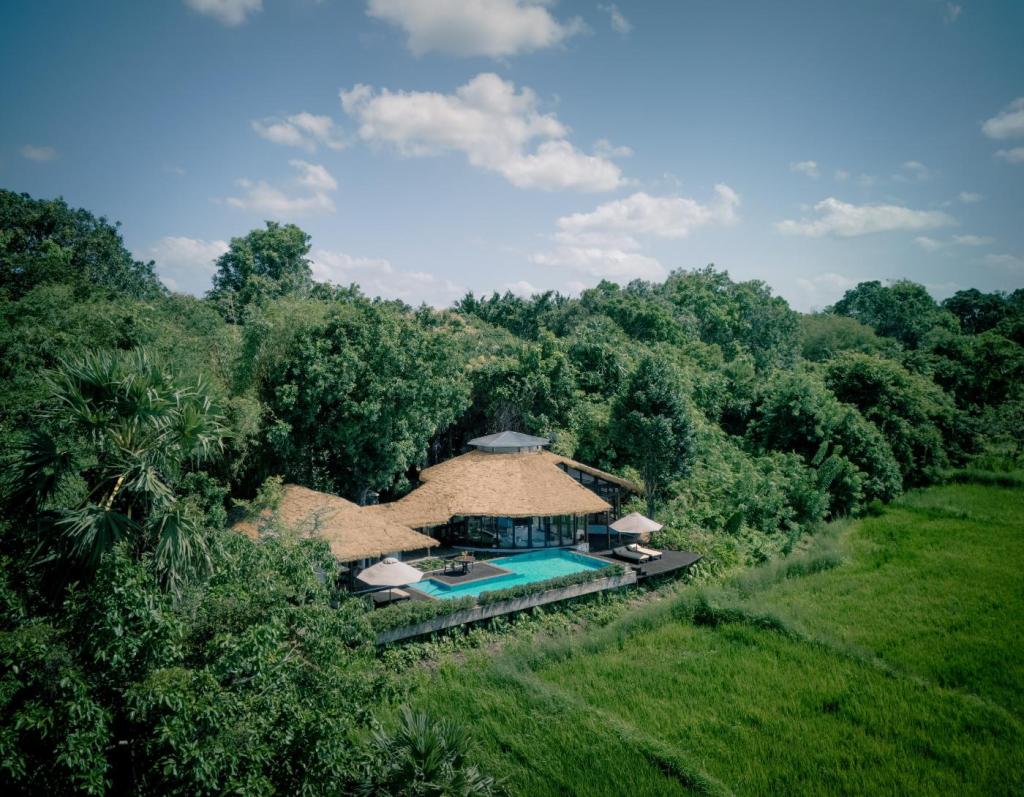
Set within Sri Lanka’s cultural triangle, Uga Ulagalla offers a landscape where wildlife moves freely across forest and open land. Spread across a 58-acre estate near the ancient city of Anuradhapura, the resort combines private pool villas with a strong connection to its natural surroundings, encouraging a slower, more immersive way of experiencing the region. At the centre of this is Katharina Raaben, Head Naturalist at the resort and the driving force behind its Elephant Research Centre.
Originally from Germany, Katharina’s journey into conservation was far from linear. After beginning her career in the corporate world, she shifted direction entirely, pursuing hands-on wildlife work in South Africa before eventually settling in Sri Lanka. Since joining Uga Ulagalla in 2020, she has led a range of conservation initiatives, including the development of the Elephant Research Centre, which is focused on understanding elephant movement, mitigating human-wildlife conflict, and working closely with local communities.
We caught up with Katharina to talk about her work and career.

How did it all start?
Growing up in Germany, I spent hours watching wildlife documentaries, completely fascinated by animals, wild landscapes, and the idea of a life far beyond what I knew. I dreamt of being out there, working with wildlife, and being part of something real. But I had no idea how to turn that dream into reality.
So, I followed a different path. I entered the corporate world and became a buyer for a German retail company. On paper, everything was going well. I built a career, climbed the ladder, and eventually earned enough to travel to the places I had once only seen on TV.
But when I got there, something felt off. The trips were perfectly organised, all-inclusive, and effortless. And yet, I felt disconnected, like I was just passing by, looking through a window. I could see everything, but I was not truly experiencing it. I was not part of it.
That realisation changed everything.
The real turning point came during a trip to the Galápagos Islands. Surrounded by incredible wildlife, I made a quiet decision: this would be my last pre-packaged experience. I did not want to observe anymore; I wanted to be involved.
Soon after, I travelled to South Africa for the first time as a volunteer. There was no luxury, no comfort zone, no special treatment, and it was exactly what I had been searching for. It was raw, real, and deeply rewarding.
From that moment on, I spent all my holidays volunteering. Each experience brought me closer to nature, to wildlife, and to myself. Then came Zululand. Working in wild dog and rhino conservation, something shifted. This was not just another experience anymore; this felt like home.
When the time came to leave and return to Germany, I was devastated. I cried like a child, not wanting to let go of a place that had given me so much. But I was not done yet. Within a week of being back, I booked another trip to South Africa. I needed clarity—and I found it. This time, when I left, there were no tears. Just a quiet certainty. I knew I was not going back to my old life.
I resigned from my job, gave up my apartment, and set off on what was supposed to be a one-year journey through South Africa and Botswana. I told myself I would return. I never did. Life had other plans.
Later, I met my now-husband in South Africa. He is a Sri Lankan national, and our journey together led me to Sri Lanka, which I have called home for the last seven years. I joined Uga Ulagalla five and a half years ago, and our research work and projects at the Elephant Research Centre (ERC) started soon after. What started as a dream is now the life I get to live every day.
What is the most intense or defining moment you had while guiding in Kruger National Park?
There are quite a few moments that I will forever remember. These moments were filled with both awe and heartbreak, highs and lows that shaped me.
My wish to see a wild elephant, and the day I actually got to see one; my first wild rhino; the day we received a call that poachers had entered the park while we were on a night drive, and my mentors pulled out their bulletproof vests and guns from under the seat, rushing to the scene — but the rhino had already been poached and slaughtered (a reality check!); the day I sat in a tree and watched elephants feeding for hours underneath me; being trapped on the loo because an elephant chose the same spot to rest, forcing me to spend the night there as I could not get out; the time we tracked a baby rhino for days after his mother had been found dead, killed by poachers, and I was able to assist in the medical treatment before it was flown off. It was a constant high and low of emotions.
I remember the day I decided that this is what I want to do and that I would leave Germany to start my wildlife and guiding career. We had been on a walking safari led by two guides, with me as a guest and a safari newbie. We spotted a breeding herd of elephants in the distance. I was so excited!
We found a safe place to watch the herd as they walked past us. They slowly came closer, and they actually walked straight past us as planned – a big herd with lots of little ones. It was a beautiful sighting and being out of the vehicle—actually on foot with elephants—was incredible.
After the herd moved on, we were all in awe, our emotions and adrenaline were high. Being on such a high from what we had just experienced, no one recognised the massive bull elephant that was following the breeding herd at a slight distance.
Out of nowhere, the big bull was standing right in front of us. The discussions are still ongoing – I think it was less than five metres, others say a bit more, but either way, much too close for comfort.
Everyone crouched down, not making a sound. I looked in front of me and could only see the foot of the elephant. I slowly raised my head: foot, leg, leg, leg, knee, leg… The elephant was massive. I froze.
Seconds and minutes passed in which I just looked at the elephant, and he was looking at us – before he showed off his tusks, raised his trunk, flapped his ears, and then moved on.
Still, no one dared to make a sound.
I was excited, scared, happy, frightened, and overall overwhelmed all at the same time. I cried quietly, actually not knowing why, and trying to hide it from the others.
Never had I been exposed to a wild elephant that close. Never had I felt so vulnerable, and at the same time so close and connected to an elephant. The stare, the way an elephant looks at you—you can feel that he is actually trying to communicate and send messages.
This was the day I felt a connection for the first time, and I am grateful that the elephant accepted our presence.
I know that this sighting did not go well, and we should never have been in a situation like that from the beginning. We should have recognised the elephant earlier and retreated in time. It was an obvious mistake.
Still, this elephant created a lasting memory and is part of my story of where I am today.

How did working in South Africa shape your understanding of human-wildlife coexistence before arriving in Sri Lanka?
As a matter of fact, most people do not even know about human–wildlife conflict because it is not part of their daily lives, and they have never been exposed to situations like this. So, wildlife-related issues simply do not exist for them.
You go on safari to see the Big Five and get a good photo — is that not the idea? Seeing the bigger picture and understanding that there may be people living in the same area where a lion roams, or that a large breeding herd of elephants has its main water source close to a village, which is also the main water source for the people, is not the first thing you think about when planning a wildlife experience. Nor do you immediately consider that people may have to cross wildlife-filled areas to reach the next village to buy groceries, or that children travel through these areas to get to school.
I did not come to Africa completely blindfolded, and I was aware of the existing issues. But I quickly got a reality check that highlighted not only the conflicts, but also how people coexist, often successfully.
Coexistence is possible, and we have had it for a long time. Most of the issues and conflicts have only emerged more recently, perhaps within the last 100 years, when the balance was disturbed and animals were pushed out of their natural environments and comfort zones.
It is a fine line that needs to be maintained, and it must not be crossed if wildlife and people are to coexist. However, humans rarely accept boundaries and tend to push them. In doing so, coexistence is threatened, and people unknowingly force nature to react in self-defence. It becomes a cycle of action and reaction, often driven by human behaviour rather than the animals themselves.
The Elephant Research Centre was launched during COVID. What was it like launching this in such a tricky period?
It is something I often say: we never planned for the Elephant Research Centre (ERC) to become what it is today. In many ways, it feels like it was simply meant to be. Perhaps COVID gave us the time and space we needed to truly focus, one positive outcome from an otherwise difficult period.
Together with my team, we made the most of that time. We spent countless hours in and around Ulagalla, exploring and observing. Although we were aware that elephants inhabited the area, we had not yet encountered them directly. What amazed us instead was the incredible diversity of wildlife living within the hotel’s premises, from fishing cats to otters, and even lorises.
Then, in January 2021, everything changed. One of our wildlife cameras captured the first sighting of a large tusker, just passing along the boundary of the property. At the time, I could never have imagined how significant that elephant would become in the years that followed.
What began as a simple logbook, recording dates, times, and locations of sightings, quickly grew. It did not take long before the pages filled up, especially as we encountered more elephants during our scenic drives. Alongside these sightings, we became increasingly aware of the challenges faced by both elephants and the local communities. Human-elephant conflict (HEC) was not just a concept — it was happening right here.
That realisation pushed us to act. This was the true beginning of the Elephant Research Centre (ERC).
We began collaborating with researchers, strengthening and expanding our fieldwork, and contributing data to island-wide research efforts. At the same time, we became actively involved in mitigation initiatives. In 2022, we constructed our first village fence, the same year the Elephant Research Centre (ERC) office was officially established.
Today, the ERC has become a place of connection. It is where we meet with guests, share knowledge, and spark meaningful conversations. While research and mitigation remain central to our work, perhaps our most important role is raising awareness.
Because in the end, education is the key to making a difference and to creating lasting change.

How different is elephant behaviour in this region compared to what people assume?
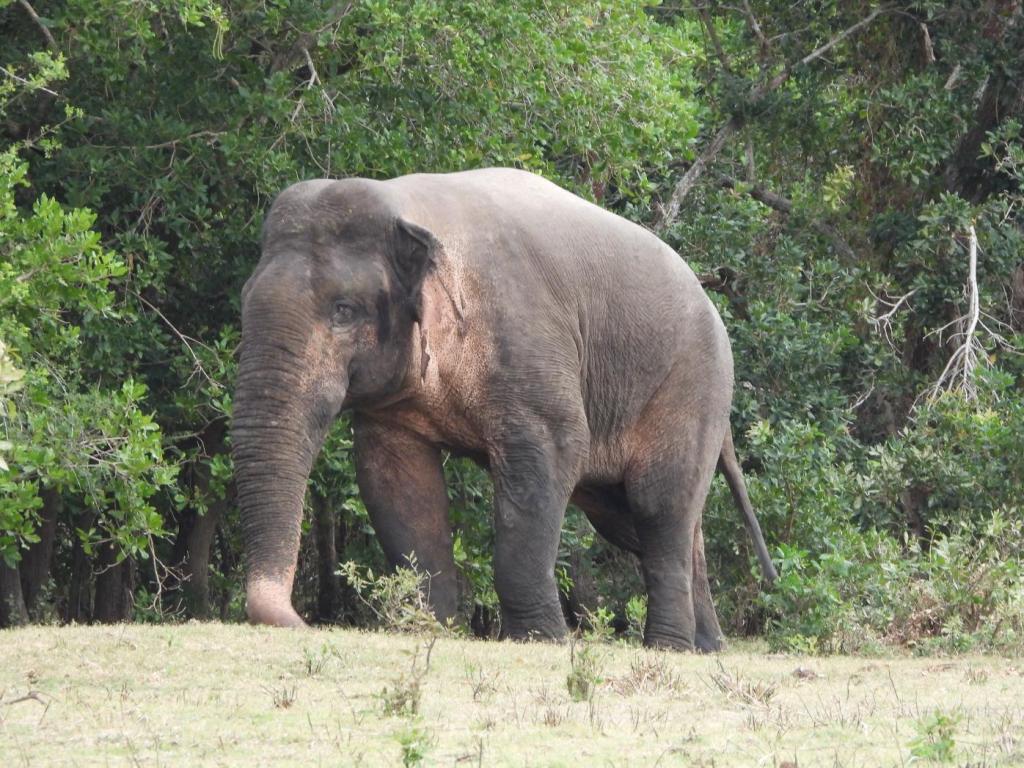
Sri Lankan elephants, and Asian elephants in general, are most of the time, falsely considered to be cute and harmless. They are even considered to be pets, which is wrong. Just because they are smaller than their African relatives, have smaller ears, and cute little hairs on their bodies, they are still elephants — wild elephants.
Elephants in captivity are mostly Asian elephants, used for work, logging, carrying tourists, in parades and processions, and also in circuses and zoos. They appear to be easy, well-trained, and calm. But few people know what it takes to make an elephant obey, and what they have to go through until they become that calm. Advertisements showing elephants close to vehicles and surrounded by people create a completely wrong impression.
This is not normal elephant behaviour, whether African or Asian elephants.
Elephants here are usually quite relaxed if you encounter them on safari in protected natural environments, as long as you respect their boundaries and step back or retreat if their comfort zones are threatened or invaded. Outside of national parks and protected areas, it is different.
While people on safari want to see an elephant and appreciate their presence, people outside of national parks do not want to encounter one. An elephant entering a village is a problem — a possible threat to people, their crops, and their homes.
Elephants are very aware of the areas they move in. They identify humans as a threat, having been chased, shot at, and hurt by people who want them to go away. So, encountering an elephant in these areas can be dangerous.
It is always important to read the signs and know when to retreat. If an elephant identifies you as a threat, it becomes dangerous, because it is also in their nature to keep themselves safe. To an elephant, you are just a human. How should it know whether you are someone who loves elephants, or someone who wants to protect their crops and might shoot it the next moment?
Elephants are very cautious and will defend themselves when needed or retreat. That said, elephants are not aggressive by nature — they can be very gentle and loving. But what would you do if you were constantly hurt and chased wherever you went?
Have you seen changes in local attitudes toward elephants since the Elephant Research Centre (ERC) began?
Yes, especially in areas where our projects take place. But it is a very slow process, and it is much harder to reach the older generation than the younger ones.
At Uga Ulagalla, we have a variety of projects, and not all of them are directly related to elephants. On one side, we have our elephant village fencing projects, which support coexistence by allowing people and elephants to live side by side peacefully, while keeping elephants out of villages.
On the other side, we have projects such as our drinking water initiatives — reverse osmosis plants, for example — which are set up to supply clean drinking water to villages that do not have access to it. These are not directly related to elephants, but in the end, they are funded by them, by the people who come to Sri Lanka to see elephants.
And this is something very important to be aware of. Elephants are an asset, and they generate significant income that helps us give back to the community in many different ways.

If you had unlimited funding, what would you do to promote Sri Lanka’s conservation landscape?
If funding and money could solve all the problems, I would be one of the happiest people — and I would probably start one fundraiser after another. Money is an essential part, but what is far more important is changing mindsets. This cannot be achieved with money alone. It takes time and passionate people to create real change.
People do not hate elephants, but they do hate being in danger and losing their income. So, unlimited funding would mean the opportunity to protect people from harm, to protect them from financial damage caused by crop-raiding elephants, for example, and to create the best possible coexistence.
I would invest in people to create change — to go into the villages where the actual problems occur, educate communities, raise awareness, and highlight the perspective of the elephants. I would set up fences where needed, create corridors for elephants to move safely along their routes, and compensate farmers for crop and property damage to reduce pressure on them, while also safeguarding the elephants at the same time.
What role does technology play in your research versus traditional tracking skills?
Technology is great and important. It speeds up analysis processes and can help identify issues and factors that have a major impact on our research results. Still, technology needs to be fed with information that is gathered, and it rarely solves problems on its own. Traditional tracking skills are essential, and I am sad that these skills are getting lost more and more.
Of course, we also use tracking cameras, for example, and we set them up at designated locations. They provide us with detailed footage of what happened within the range the camera is capturing. But their output is limited.
Since my early days of guiding, I have been fascinated by tracking. You would be surprised how many signs you can find on an early morning walk about what might have happened the night before. You walk along a path and spot footprints. You can identify the species and the direction it was heading. You can also estimate the size of the animal, its age, and even the size of the group. Was it one elephant or more? Was it walking fast or slow?
If a pile of dung is still moist and warm, it is quite fresh. Sometimes there are mango seeds and paddy grains in it as well. The elephant must have visited the village recently. There you go — you even know what the animal ate. Some broken branches on the side show that it was feeding along the route. Fresh, still-green leaves lie on the ground. And here, a wet area – something splashed, and there is a strong smell. Is the elephant in musth?
There are so many signs around, but people rarely see them or know how to interpret them. The tracks and signs come alive if you immerse yourself in them, and you might even be able to picture the elephant walking in front of you, even though it may have been hours ago. The stories are written and imprinted in the ground — nothing that technology alone can tell you. It is a skill.
This is also why working with the local community is so important. Villagers have been facing issues with elephants for years, even for generations. They are real experts. They know when elephants are coming, what they are doing, and where they are heading — based on experience and the signs the elephants leave behind.
What is next for you and Uga Ulagalla?
I am very proud and grateful when I look at the ERC today, knowing what we have achieved so far and what lies ahead. We are currently in the middle of constructing another village fence, and I inspected it just a few days ago.
It is about having an impact and making a difference. Besides seeing elephants, meeting the communities we work with is always one of my personal highlights. It is a very rewarding feeling to know that the work we do has a real impact on people’s lives, supporting and addressing issues that most people could not imagine or are not even aware of.
Life is different in rural communities, and so is the kind of support that both people and elephants need.
I am looking positively towards the future and towards the many new projects we already have in mind, and I am grateful to have the strong and supportive management of Uga Resorts with me. Uga is expanding, and we are opening more properties in different areas of the island, each with different needs and opportunities for us to reach out and lend a helping hand.
To discover more, visit: Uga Resorts
Ver esta publicación en Instagram
All imagery courtesy of Uga Ulagalla.