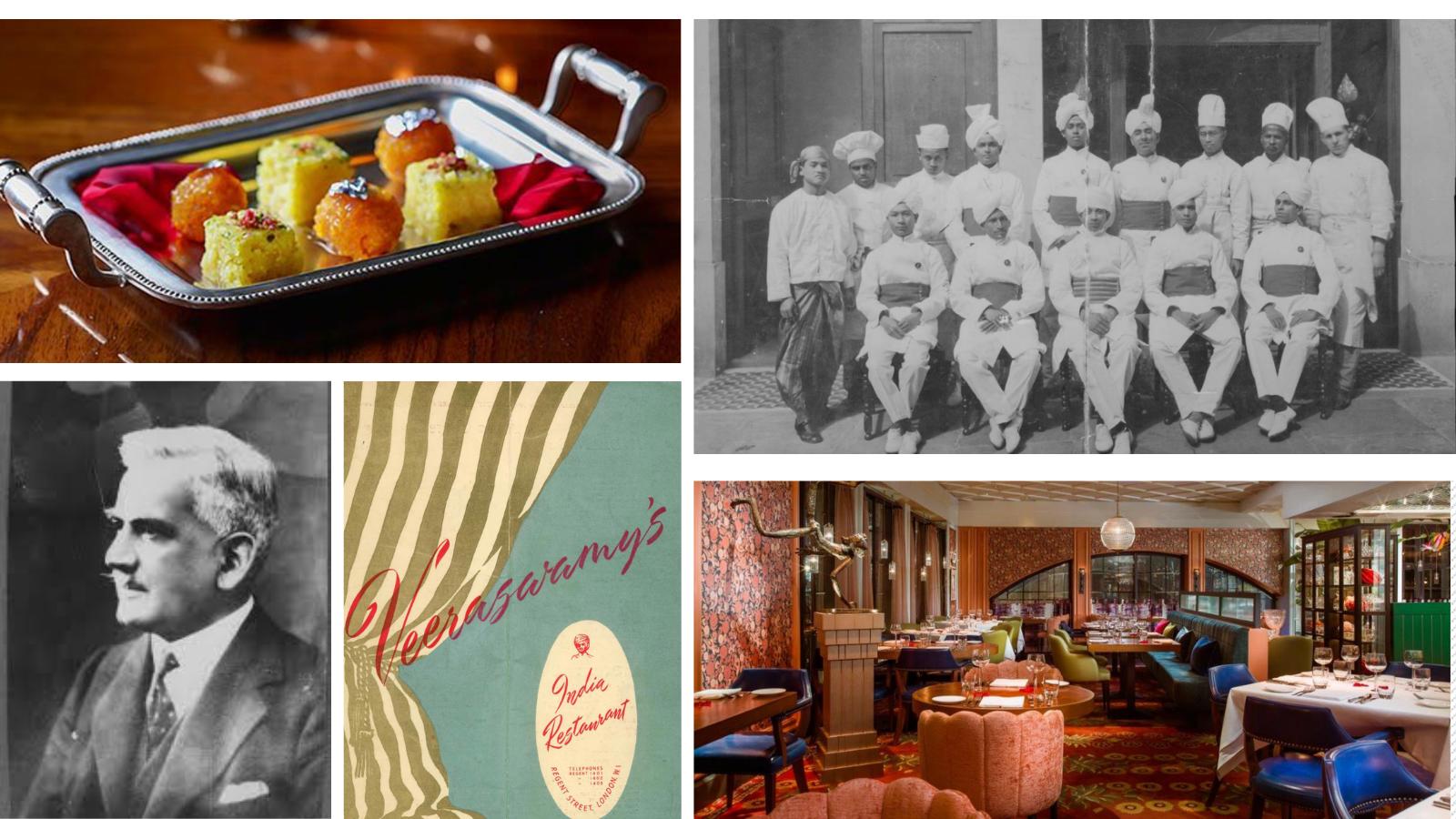
There are very few restaurants in the world that can claim a century of continuous service. Veeraswamy, the Michelin-starred Indian restaurant perched on the first floor of Victory House at 99 Regent Street, is one of them.
Sitting alongside Rules and Wiltons as one of the three oldest restaurant institutions in London, Veeraswamy has now reached its extraordinary 100th anniversary. To mark the occasion, it has launched a special Nostalgia Menu: a four-course journey through the decades that tells the story of Indian dining in Britain through the dishes that defined it.
Available from 26th March 2026, the Nostalgia Menu is based on an archive of historic menus to revive and reimagine the dishes that have shaped Veeraswamy’s identity over the past century. Each course is related to a specific era and a specific story, from the restaurant’s Anglo-Indian origins in 1926 through to the regional Indian cooking that earned it a Michelin star 90 years later. This is food with history in every bite.

A History Steeped in Royalty and Spice
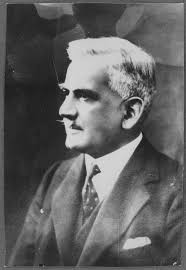
Veeraswamy was founded in 1926 by Edward Palmer, a retired Anglo-Indian officer whose great-grandfather, General William Palmer, had been military secretary to Warren Hastings (the first Governor General of India) and a trusted banker to the Nizam of Hyderabad. Palmer’s great-grandmother was the Mughal Princess Faisan Nissa Begum, and it was from this extraordinary lineage that he inherited his deep connection to the royal kitchens of Hyderabad and his lifelong passion for Indian food.
Palmer came to England in 1880 to study medicine, but food won out. He established a spice business in 1896, published a cookbook called Indian Cookery for Use in All Countries (which remained in print for over a century), and in 1924 ran the restaurant at the British Empire Exhibition at Wembley, reportedly serving 500 curries a day. When he opened Veeraswamy on Regent Street two years later, his vision was to recreate the splendour of a Maharaja’s palace for London diners, and to educate them on the extraordinary depth and variety of Indian cuisine. Over the decades, the restaurant welcomed guests including Winston Churchill, Mahatma Gandhi, Charlie Chaplin, Jawaharlal Nehru and Marlon Brando. It catered for the Indian contingent at the 1948 London Olympics, and in 2008 became the first outside caterer ever invited to cook at Buckingham Palace.

The Veeraswamy Nostalgia Menu: Four Courses, One Hundred Years
What makes this menu special is not just the quality of the cooking, but the way each dish has been chosen to represent a chapter in the restaurant’s story. The kitchen has gone back through the archives, pulled out the menus from each decade, and selected the dishes that best capture the spirit of their era. The result is a meal that is as much a history lesson as it is a feast.
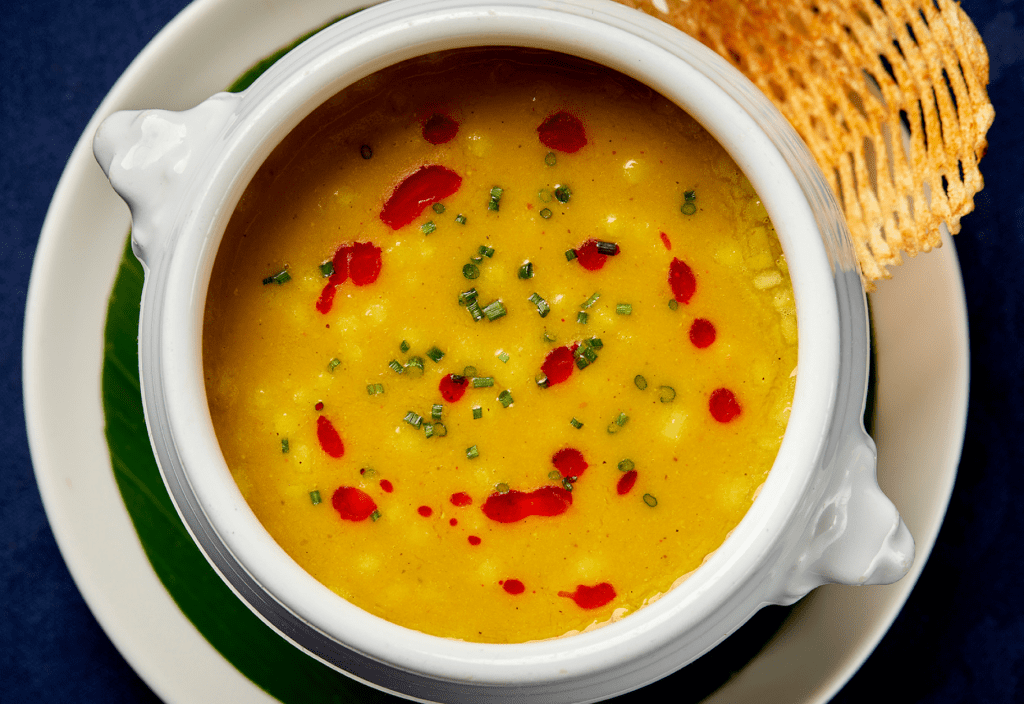
First Course: Anglo-Indian Mulligatawny Soup (1926)
The meal opens with the dish that has been on the Veeraswamy menu since the very first day: Anglo-Indian Mulligatawny Soup. Of all the dishes on the Nostalgia Menu, this is the one with the deepest roots, and perhaps the most moving story.
Mulligatawny takes its name from the Tamil words for ‘pepper water’ or ‘chilli water’. In Southern India, pepper water was traditionally served alongside dry curries as a thin, brothy accompaniment. In Northern India, various types of dal and vegetables were used to produce shorbas and rasams: light, fragrant soups. When European and Anglo-Indian cooks encountered these traditions during the days of the Raj, they adapted them into something new: a lentil-based soup enriched with pepper, lemon and a careful blend of spices, designed to serve as a formal first course in the British dining tradition. No self-respecting army officer would begin a meal without soup, even in the Indian heat, and mulligatawny became the answer to that peculiar demand.
The dish was once everywhere on Indian restaurant menus across London, but over the decades it has become something of a rarity. At Veeraswamy, it has never left the menu. The version served today is refined and beautifully balanced: warm, deeply fragrant, with a gentle heat that builds across the palate and a richness that comes from the slow cooking of the lentils and spices. It is a dish that bridges two food cultures, and it is the ideal starting point for a menu that traces the evolution of that very bridge over a hundred years.
Second Course: Country Captain with Roghni Naan
The second course is a tribute to Veeraswamy’s founder, Edward Palmer, and to his tireless work introducing Indian flavours to a British audience long before the restaurant even existed.
Before he became a restaurateur, Palmer was a prolific advocate for Indian cuisine. He gave cooking demonstrations across London, wrote recipes for newspapers and magazines, and sold Indian spices, pickles and chutneys through his company under the ‘Nizam’ trademark. One such cooking demonstration, reported in The Lady’s Pictorial magazine, featured a dish called Country Captain. The publication advised its readers that the dish could bring a novelty to European tables, and that Palmer’s recipes could not fail to prove generally useful.
Country Captain is a lightly spiced chicken curry that occupies a fascinating place in culinary history. The name is believed to derive from the British army captains stationed in India who brought variations of this recipe back to England (and, later, to the American South, where it became a celebrated dish in its own right, famously served to Franklin D. Roosevelt). In its original Anglo-Indian form, it is a dish of relaxed elegance: chicken cooked gently with onions, turmeric and a restrained blend of spices, without the heavy sauces or intense heat that many associate with Indian food. It is the kind of dish that was designed to introduce, not overwhelm, and it captures the spirit of Palmer’s mission: to show the British public that Indian cooking was sophisticated, varied and worthy of a place at any table.
Accompanying the Country Captain is Roghni Naan, a rich, slightly sweet bread brushed with ghee that featured on Veeraswamy’s earliest menus. Roghni naan is a Mughal-influenced bread, its name coming from the Persian word for ‘clarified butter’, and it was traditionally served at royal tables across Northern India. The pairing is simple but evocative: two dishes that connect directly to Palmer’s world, one a demonstration of his advocacy for Indian food in England, the other a staple from the restaurant’s very first kitchen.
 Main Course: An Independent India (1947/1959)
The main course invites diners to choose between two dishes, each tied to a defining moment in Indian and British history. It is here that the Nostalgia Menu moves beyond the Anglo-Indian era and into the richer, more regionally specific cooking that would come to define Veeraswamy’s modern identity.
The first option is the Hyderabadi Lamb Salan Curry, drawn from the 1947 menu, the year India gained independence from British rule. Salan (meaning gravy or sauce) is a style of cooking rooted in the royal kitchens of the Nizam’s court in Hyderabad, the very kitchens that Palmer’s own family had been connected to for generations. A true salan is built slowly and deliberately: whole spices are toasted until fragrant, onions are cooked to a deep gold, and the base is enriched with tamarind, coconut and ground sesame or peanut to create a sauce of extraordinary complexity. The lamb is braised slowly until it falls apart at the touch of a fork, absorbing the warmth and depth of the sauce around it. This is a dish that represents a turning point not just in Indian history but in the restaurant’s own evolution. By the late 1940s, the menu had begun to move beyond the simple Anglo-Indian curries of its early years, embracing the regional specificity and culinary sophistication that would eventually earn Veeraswamy its Michelin star.

The second option is the Ceylon Prawn Curry, representing 1959. By this point, Veeraswamy’s menu had expanded to feature dishes from across the subcontinent and beyond, drawing on the culinary traditions of India, Pakistan, Malaya and Ceylon (now Sri Lanka). The 1959 menu is also historically significant because it contains the first recorded entry of tandoori food in the UK: Sir William Steward, who had taken over the restaurant in the 1930s and dedicated over 30 years and 200,000 miles of travel through India to refining its offering, secured Britain’s first tandoor oven for the restaurant during this period. The Ceylon Prawn Curry speaks to that same spirit of exploration and ambition. It draws on the coastal cooking traditions of Sri Lanka, where prawns are cooked in bright, coconut-rich sauces seasoned with curry leaf, mustard seed, fenugreek and tamarind. The result is a dish that is at once warming and fresh, rich but not heavy, with the sweetness of the coconut balancing the sour tang of the tamarind and the gentle heat of the spices. It is a world away from the mulligatawny soup that opened the meal, and that distance is precisely the point.
A Sweet Finale
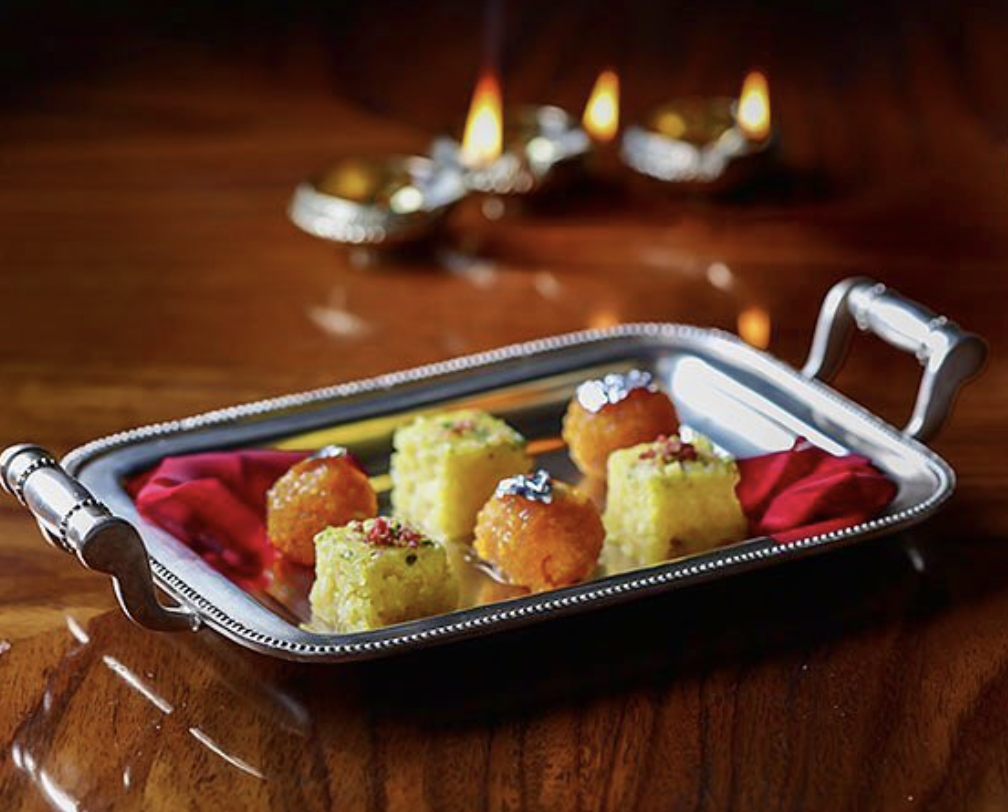
Dessert brings the journey to a celebratory close with a trio of classic Indian sweets: mini gulab jamun, black carrot halwa and patli jalebi. Each of these sweets has a long history in Indian cuisine, and together they represent the tradition of mithai (Indian confectionery) that has been central to celebrations and festivals for centuries.
Gulab jamun are the soft, syrup-soaked dumplings that are arguably the most recognisable Indian sweet in the world. Made from milk solids (khoya) and flour, they are deep-fried until golden and then soaked in a cardamom and rose-scented sugar syrup. The name translates roughly as ‘rose berry’, a nod to both the rose water in the syrup and the small, round shape of the dumplings. At their best, they are pillowy, fragrant and impossibly moreish, and they carry an emotional weight for many Indian diners that goes beyond the taste alone. They are the sweet you find at weddings, at Diwali, at every gathering that matters.
Black carrot halwa is a lesser-known treasure. Unlike the familiar orange carrots used in the more common gajar ka halwa, this version uses black carrots, a variety native to parts of North India and Central Asia. These carrots are darker, earthier and slightly more complex in flavour, and when slow-cooked with ghee, sugar, milk and cardamom, they produce a halwa that is dense, warming and deeply satisfying. At Veeraswamy, the black carrot halwa has become something of a signature, earning praise from both diners and critics. It is the kind of dessert that rewards patience: the slow cooking concentrates the flavours and produces a texture that is at once rich and surprisingly light.
Finally, patli jalebi adds a textural contrast and a flash of gold to the plate. Jalebi are made by piping a fermented batter into hot oil in tight, spiralling patterns, frying them until crisp, and then soaking them briefly in a saffron-infused sugar syrup. The ‘patli’ variation is a thinner, more delicate version, which means the ratio of crisp batter to sweet syrup is higher, giving each bite a satisfying crunch before the saffron sweetness hits. Jalebi have been part of Indian street food and festival culture for centuries, and their inclusion here is a fitting conclusion to a meal that celebrates a hundred years of bringing Indian food to London.
The Dining Rooms: Stepping Into Another World
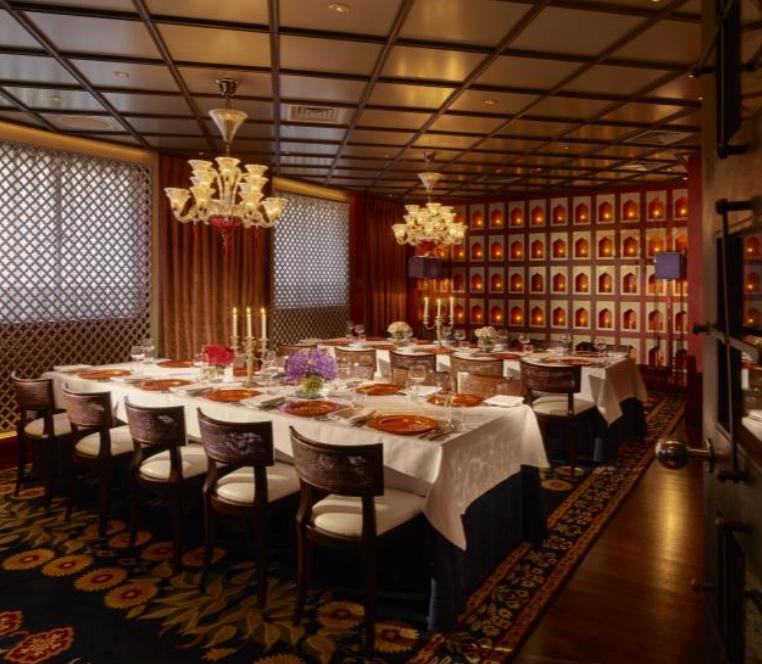
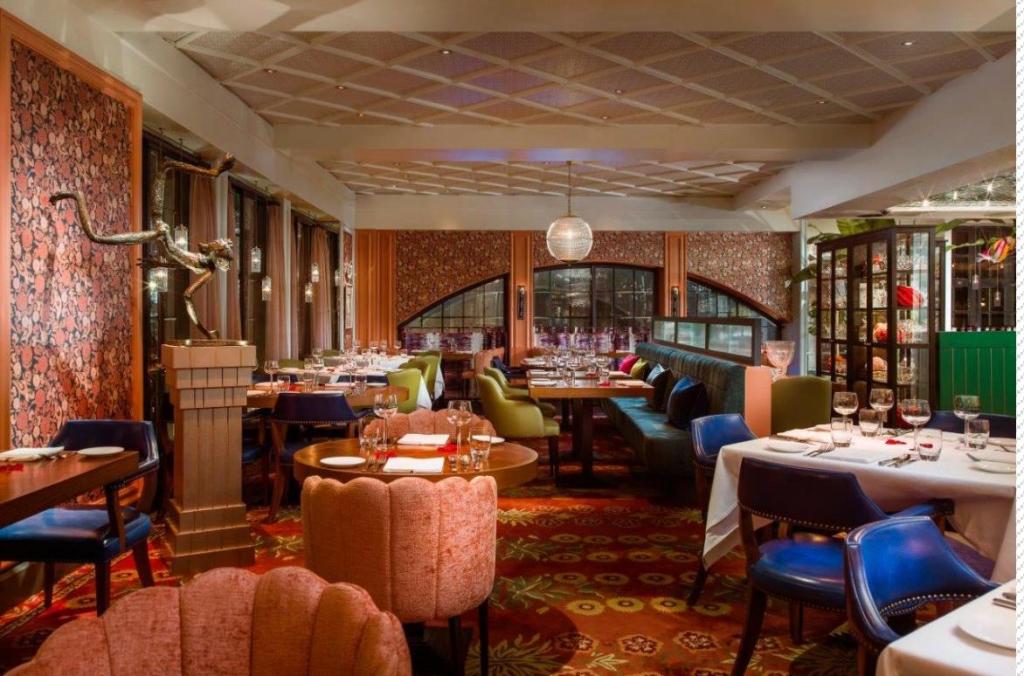
The restaurant’s interiors are a lavish homage to the 1920s Maharaja’s palace that Palmer originally envisioned. Three distinct dining areas, the Regency Room, the Verandah Room and the Paisley Room, each offer their own character, from eclectic luxury and sweeping Regent Street views to 1920s velvet and flowing fabrics. Handwoven floral carpets, glass paintings from Rajasthan, Kalighat paintings from the 1920s, and handmade Venetian-style chandeliers from Jaipur fill the space with colour and warmth. Tables are set with fine tableware and scattered with fresh scarlet rose petals. A private dining room seating up to 22 guests is also available for special occasions.
Service is effortlessly charming and very in keeping with the room.
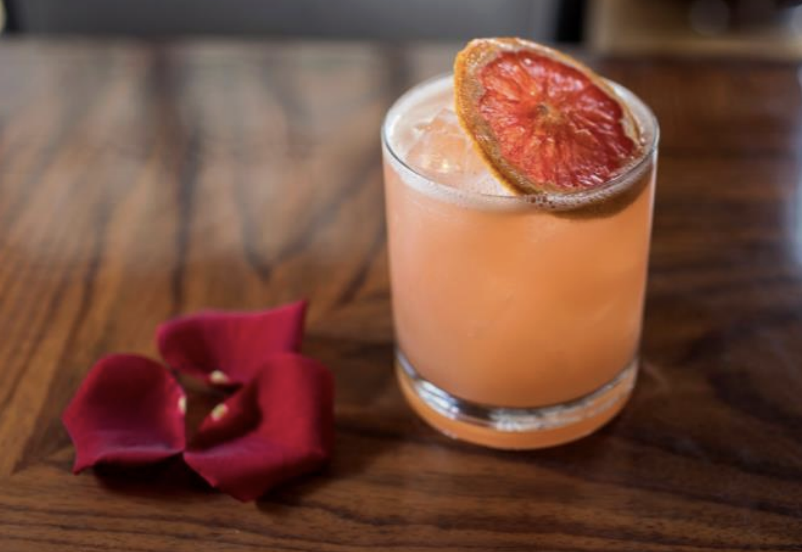
Image Courtesy of Veeraswamy’s Instagram
Drinks: From Danish Lager to Fine Wine
The wine list, curated by Master of Wine Justin Howard-Sneyd, features artisanal producers alongside iconic winemakers from both the Old World and the New. English sparkling wine from Nyetimber and Chapel Down features prominently, along with fine Bordeaux, Burgundy and more adventurous picks like Austrian Furmint and Greek Assyrtiko. Cocktails are blended with fresh seasonal ingredients and given a spicy twist, including the signature 1926 Cocktail. And for those who appreciate the history: the British tradition of drinking lager with curry is widely believed to have started at Veeraswamy in 1924, when Prince Axel of Denmark sent a barrel of Carlsberg to the restaurant every year after falling in love with the pairing of beer and Indian food.
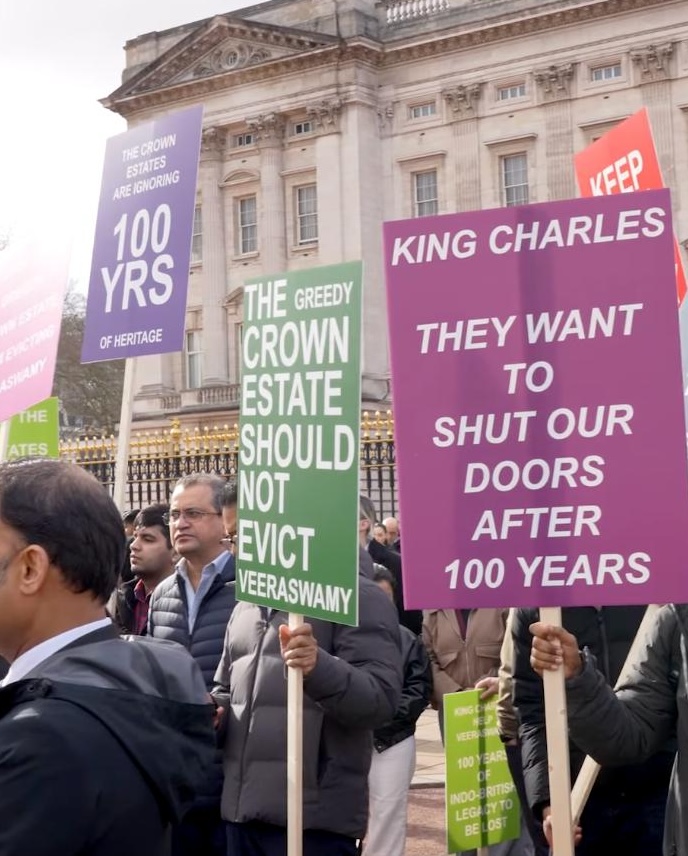
Image Courtesy of Veeraswamy’s Instagram
A Celebration With a Cause
The centenary comes at a bittersweet moment. Veeraswamy is engaged in a legal dispute with its landlord, the Crown Estate, which has declined to renew the lease on Victory House. The ‘Save Veeraswamy’ campaign has gathered over 20,000 petition signatures, with high-profile supporters including Raymond Blanc, Michel Roux and Richard Corrigan backing the cause. The restaurant’s co-owners, Ranjit Mathrani and sisters Namita and Camellia Panjabi, have taken their case to Buckingham Palace. The restaurant’s name itself carries a fighting spirit: Veeraswamy comes from the Sanskrit word veera, meaning brave or courageous. As its owners have noted, if Veeraswamy could survive the Blitz, it can surely overcome an ill-considered redevelopment plan.
For more information, visit Veeraswamy
View this post on Instagram
All Images Courtesy of Veeraswamy unless stated otherwise.