Burgundy poured into Berkshire at Coworth Park, where the fortunes of an English estate, and the history of France’s most scrutinised vineyards, revealed a rhythm as entwined as vine and trellis.
The dinner was staged at Woven, Adam Smith’s flagship, imagined by Martin Hulbert as a woodland interior, its plaster relief carved with root vegetables by Locker & Riley, the atelier that shaped The Dorchester’s ornate ceilings. Ceramic conkers stood sentinel on tables, while pendant lights were lowered at the start of service, glowing like moons over the feast to come.

A Ground with Memory
Coworth’s land has long carried power. Granted by Edward the Confessor to Westminster Abbey, it was reclaimed by William the Conqueror for the Crown, then leased to the Powney family of Old Windsor. The house itself was a Georgian creation of 1776, yet the pattern of possession – faith, crown, commerce – echoed Burgundy’s own passage from monastic vineyard to secular trade, reshaped by revolution, inheritance law, and the rise of négociants.
Raised for William Shepheard, an East India merchant enriched by empire, Coworth passed in 1836 to Colonel George Arbuthnot, returned from Madras with colonial service behind him. He was followed by his nephew and son-in-law, John Alves Arbuthnot – banker, co-founder of Arbuthnot Latham, and High Sheriff of Berkshire in 1873 – part of the Victorian caste which treated land as both symbol and investment. Coworth held together; Burgundy did not. Its vineyards were seized in the Revolution, fractured by Napoleonic law, parcel by parcel turned into fortunes by négociants.
By 1883, Coworth was owned by William Farmer, merchant prince, Sheriff of London in 1890–91 and, like Arbuthnot before him, also High Sheriff of Berkshire – a comfortable house at the moment Burgundy staggered under phylloxera, its earlier trial with oidium barely past, and its survival secured only by grafting onto American rootstock. One estate stood firm, the other endured, diminished but not extinguished.
The next chapter came in 1899, when Farmer sold Coworth to Edward George Villiers Stanley, later the 17th Earl of Derby. The date aligned with Burgundy’s 1899 – a vintage of ripeness and stamina, reckoned one of the greats. At Knowsley Hall near Liverpool, the Stanleys presided over cellars of breadth and ambition, Burgundy almost certainly among them. Their name was already immortalised in racing – the Derby at Epsom carrying it worldwide. Coworth, by contrast, became the Earl’s sporting outpost, a Berkshire annex to Knowsley’s orchestration of wine and horses, with Ascot Racecourse fewer than two miles away.
The Earl’s tenure lasted until 1948, one year after Burgundy’s legendary 1947 – velvet richness announcing an ending. When Lady Derby died in 1957, the family’s connection ceased. Coworth became St John’s Convent School. Burgundy’s 1957, thin and joyless, felt similarly ascetic.

Renewal
Coworth was sold to Harold Bamberg, chairman of British Eagle Airways, who turned the house into multi-occupation offices. Clerks clattered typewriters in rooms meant for Georgian repose; carbon paper and filing cabinets replacing refinement. Burgundy, by then, was more likely poured from a trolley at thirty thousand feet, altitude lending glamour to what had become Coworth’s most pedestrian chapter.
In the 1980s, Canadian magnate Galen Weston laid polo fields across the grounds, a feature which would later make Coworth the only luxury hotel in the country where guests can watch a match in play. Today those fields form the Guards Polo Academy, the official outpost of Guards Polo Club beyond Windsor. Weston was steeped in food and retail: his family empire spanned Fortnum & Mason and later Selfridges, their cellars stocked with Burgundy. The 1985 vintage proved enduring – a classical, structured year still alive today. By contrast, Weston’s passing in April 2021 followed Burgundy’s blackest spring frost in memory, yields slashed to almost nothing, yet Burgundy and Coworth alike endured – flayed, but unbroken.
In 2001, Coworth joined the Dorchester Collection. With the patience of a vigneron rebuilding terraces after a landslide, the house closed in 2008 for restoration, its Georgian front perfected and new spa unveiled. Burgundy’s 2010 mirrored this optimism: poised, precise, its classical geometry restored.
In September 2022 came Woven by Adam Smith. Having started as a pot washer, then rising through kitchens including the Ritz before arriving at Coworth in 2016, Adam Smith returned to the estate’s table in dazzling form; within six months of opening, Woven itself earned a Michelin star. Burgundy’s 2022 vintage, plentiful after 2021’s devastation, formed the spine of the evening – renewal embodied in both vineyard and room.
The Feast
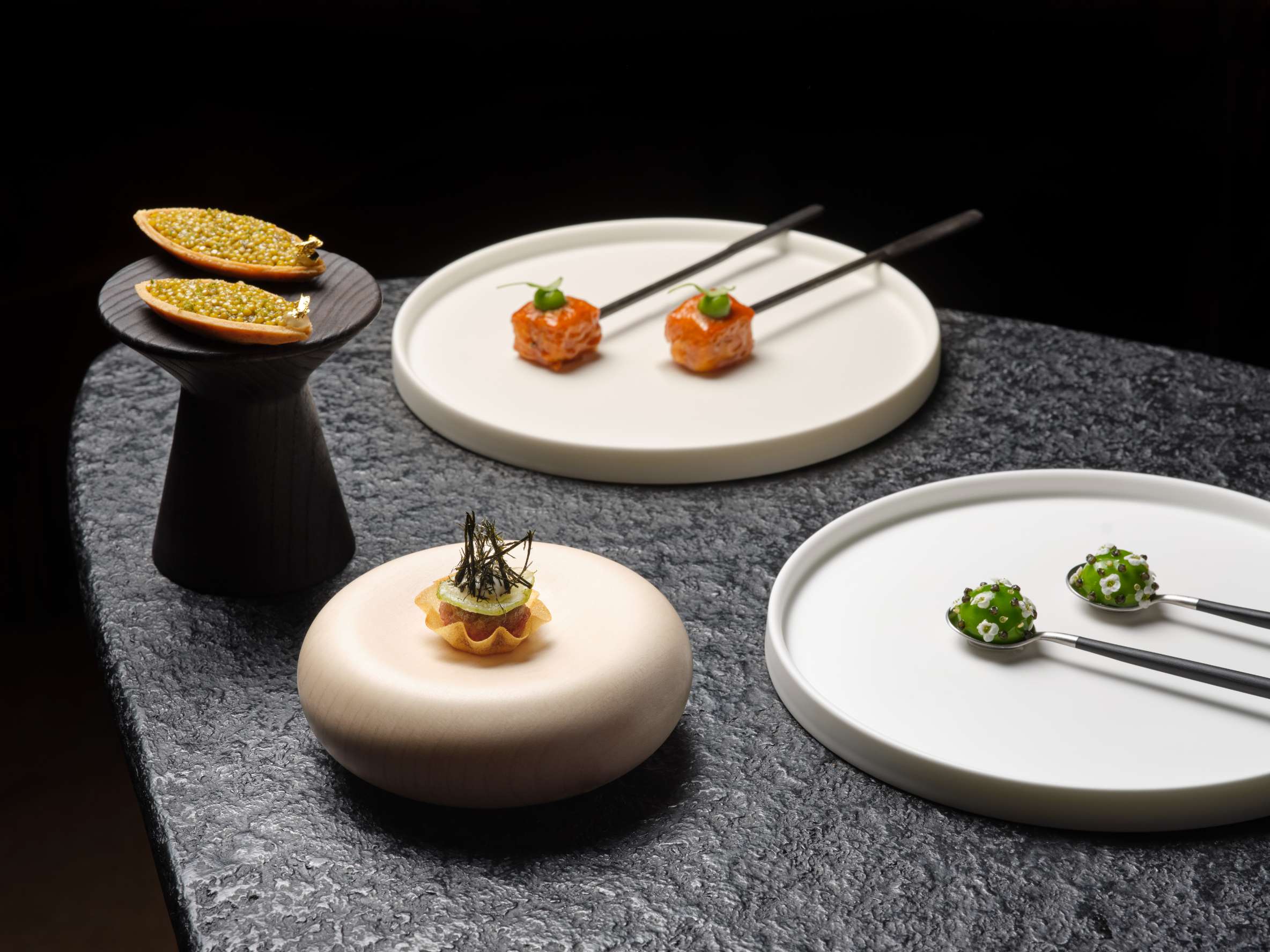
First came Vincent Dampt Chablis Premier Cru Les Vaillons 2023 – saline, youthful, incisive – set against amuse-bouches pitched between memory and extravagance: a quince-and-cola Jammy Dodger; a truffle doughnut, no larger than a Malteser, yet indecent in its richness; a tuna and apple, marigold tart capped with Kaluga caviar; and Cornish crab in Thai green curry custard, served in a volcanic cup.
Tim Wheeldon of Corney & Barrow guided with finesse. Burgundy, he reminded, accounts for roughly three percent of France’s production, and half a percent of the world’s – yet dominates auction catalogues, fine-dining lists and collectors’ cellars with a force far greater than volume. Few merchants know the terrain better: Corney & Barrow has held Domaine de la Romanée-Conti’s UK agency since 1991.
From the Côte de Beaune came Bachelet-Ramonet Chassagne-Montrachet 2023 – broad-shouldered and oak-framed – set against raw scallop dressed with apple, kohlrabi, Kaluga caviar, and dill. Dill, usually the enemy of sommeliers for its way of muting wine, here fell into line under the breadth of the young Chassagne. The progression stayed in the Côte de Beaune with Georges Glantenay Volnay 2022 – precise, silken – served beside a raviolo of cep, magnificent, earthy yet weightless.

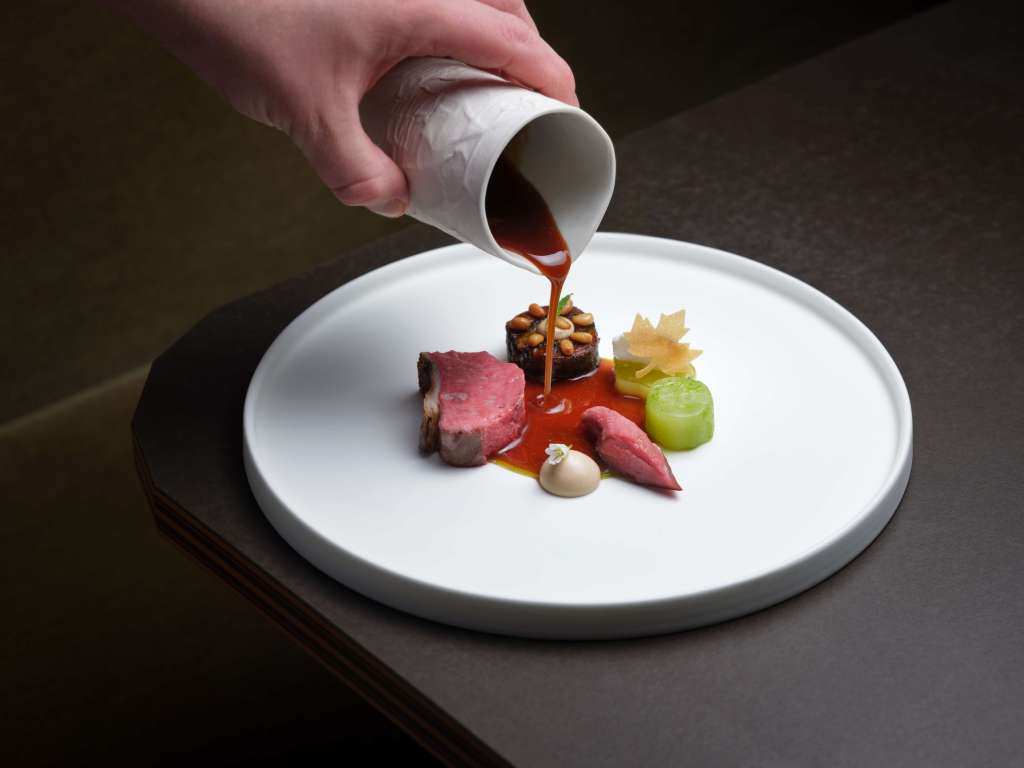
Then came the season’s prize: Smith’s first grouse with Savoy cabbage and pickled elderberries, its richness underscored by a croissant crammed with truffle and duck liver – decadent, teetering, but triumphant. To match, Rossignol-Trapet Gevrey-Chambertin Vieilles Vignes 2022, biodynamic, its faint haze carrying perfume of game and a structure of measured power. Burgundy has no grouse of its own – the bird is as British as drizzle – yet the pairing spoke fluently across borders.
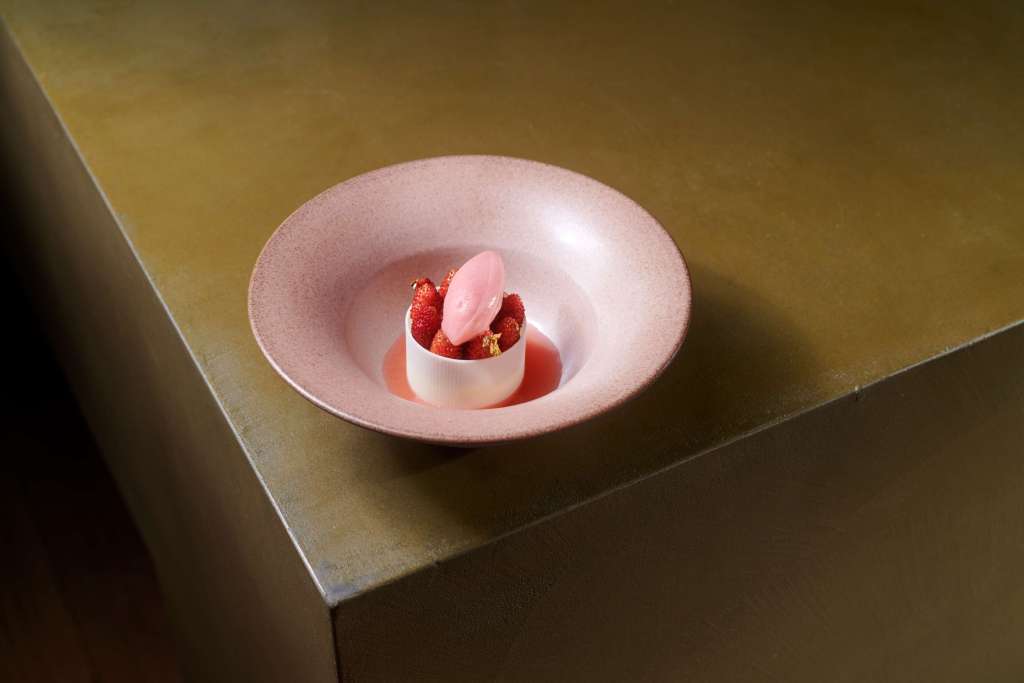
Dessert brought Pink Lady apple with almond, blackberry and green apple sorbet, paired with Crémant de Bourgogne Rosé NV from Louis Bouillot – Pinot Noir, Gamay and Chardonnay. Gamay’s presence is historical: in 1395, Philip the Bold, Duke of Burgundy, condemned it as ‘a very bad and very disloyal plant,’ ordering vines ripped out so Pinot Noir might define Burgundy’s reputation. Gamay retreated south to Beaujolais. Sparkling, cheerful, usually a beginning, here it was deliberately the conclusion. Petits fours followed: sloe jelly alcoholic to its core, made with berries gathered on the estate – hedgerow-British yet shaking hands with Burgundian fizz.

Burgundy in Berkshire
By the close, Berkshire was woven into Burgundy’s fabric: monks and nuns, merchants and bankers, earls and magnates, airmen and polo players, and sommeliers and chefs gathered in chorus.
Both Coworth and Burgundy, weathered and sometimes wounded, yet forever renewed, revealed themselves as living continuums. In rooms such as this, fine wine overwhelms, and on this night it was unmistakable: 2022 defined the evening – generous, fruit-laden, a vintage of revival carried beyond the vineyard into Coworth itself. And should the estate’s green and pleasant lands, rooted in the same chalk seam as Champagne and England’s finest sparkling vineyards, ever yield to Pinot Noir and Chardonnay, the estate might pour wine of its own – rivalry and homage in a single glass, a Berkshire accent added to Burgundy’s ancient tongue…
Coinciding with Thanksgiving, the next wine dinner will showcase the cream of California’s wines on 27th November. (£220, dorchestercollection.com/ascot/coworth-park/whats-on/california-wine-dinner)
For more information, visit dorchestercollection.com
Ver esta publicación en Instagram
Photo credit: All images courtesy of The Dorchester Collection.