Cartier watch resale value in 2026: which models hold their value
Cartier has moved from a jeweller with watches to a genuine collector’s brand. Chrono24’s 2025 market review recorded 8.3% year-on-year growth in Cartier’s share of completed transactions, driven by steady demand for the Santos and Tank rather than new launches. Younger buyers are a large part of the story: Chrono24 data shows Cartier’s share of Gen Z watch sales rising from 1.7% to 6.8% over seven years.
That demand is showing up in prices. According to Suttons & Robertsons, most Cartier watches in 2026 resell for between 55% and 75% of their original retail price. Pricing platform WatchCharts also recorded Cartier values rising by around 10% over the 12 months to 17 August 2026.
So, do Cartier watches hold their value? Broadly, yes, though the answer shifts considerably by model, size and metal. Below are the five collections that matter most to UK owners and buyers.
A note on the figures: unless shown in pounds, the percentages compare WatchCharts’ secondary-market prices with current retail, using US pricing, as of October and November 2026. They reflect prices between buyers and sellers; a dealer buying outright will usually offer less.
1. Cartier Tank
History: Louis Cartier designed the Tank in 1917, reportedly drawing on the outline of First World War tanks seen from above. The rectangular case and its vertical sides, known as brancards, have barely changed in over a century.
Design, sizes and metals: The Tank Louis Cartier is the purist’s version, now offered mainly in gold in small and large sizes. The Tank Must, revived in 2021 from the Must de Cartier line of the 1970s, is the steel entry point in small, large and extra-large. The Tank Française, launched in 1996 and redesigned in 2023, adds an integrated steel bracelet, while the Tank Américaine, introduced in 1989, stretches the case into a longer, curved shape.
Resale performance: The Tank collection averages about 75% of retail. The steel Tank Must Large (WSTA0041) trades at around 90%, current gold Tank Louis Cartier references at roughly 76% to 78%, and the steel Tank Française at 66% to 70%. The discontinued steel Tank Américaine (WSTA0045) sits near 83% of its last listed retail price.
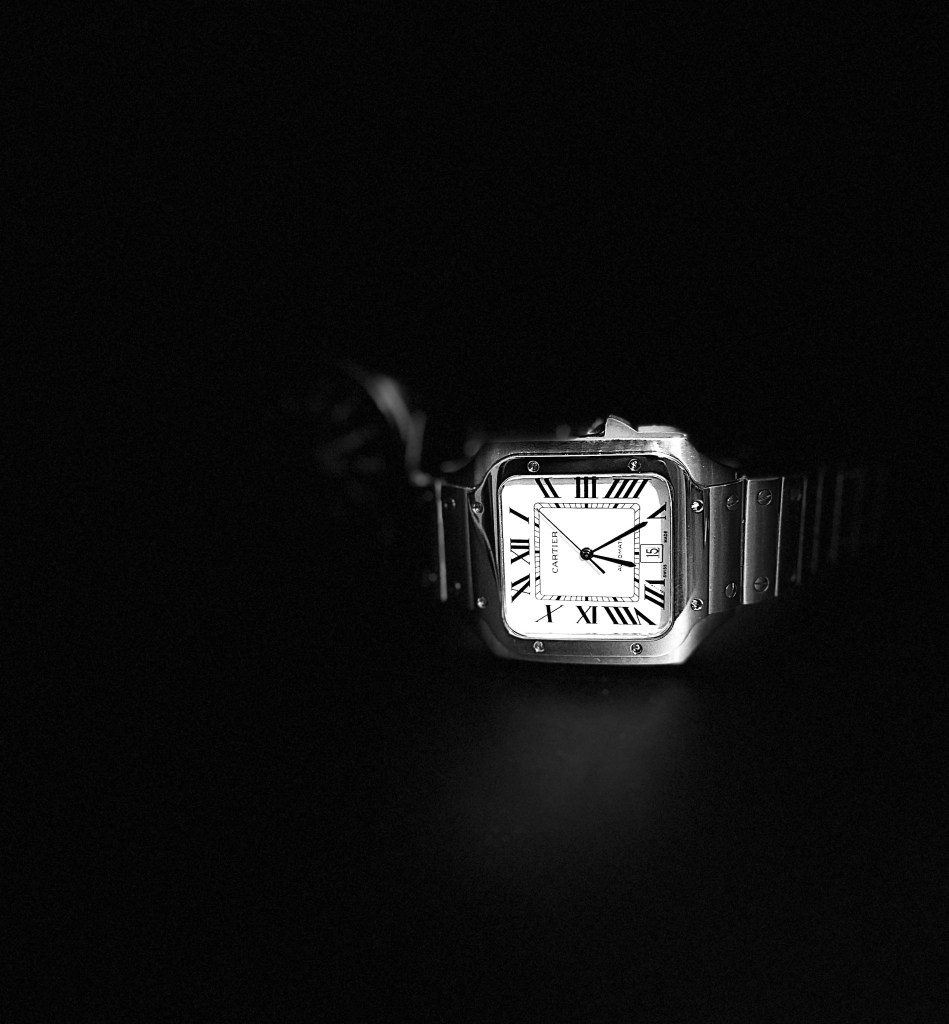
Photo by Keyur Jadav on Unsplash
2. Cartier Santos
History: Created in 1904 for Brazilian aviator Alberto Santos-Dumont, who wanted to read the time without taking his hands off the controls, the Santos is one of the earliest men’s wristwatches.
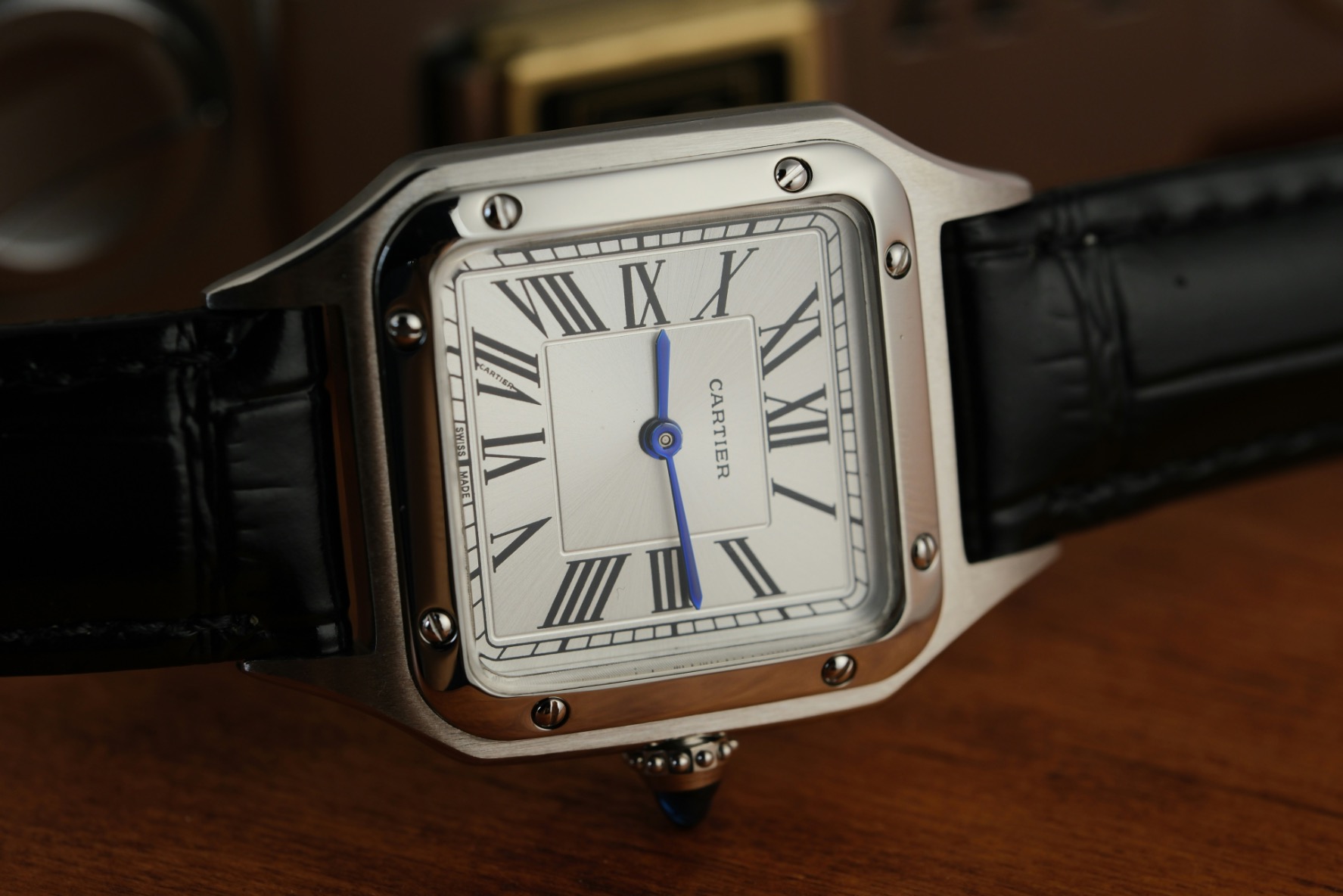
Design, sizes and metals: Its square case and exposed screws on the bezel and bracelet are instantly recognisable. The Santos de Cartier was relaunched in 2018 with tool-free strap changes and bracelet sizing, in medium and large cases in steel, two-tone and gold. The Santos-Dumont is the slimmer dress version, relaunched in 2019 in quartz small and large sizes and a hand-wound extra-large.
Resale performance: The Santos collection averages around 77% of retail. The steel Santos de Cartier (WSSA0063) trades at about 89%, and the steel Santos-Dumont (WSSA0023) currently changes hands slightly above retail, at around 103%.
3. Panthère de Cartier
History: Introduced in 1983, the Panthère became one of the defining jewellery watches of its era. Cartier brought it back in 2017.
Design, sizes and metals: A square case sits on a supple, brick-patterned link bracelet that drapes like jewellery. It comes in mini, small and medium sizes, in steel, two-tone, yellow gold, rose gold and diamond-set versions.
Resale performance: WatchCharts’ first-quarter 2026 report named the Panthère the best value-retaining Cartier collection, at about 12% below retail, or roughly 88%. It also led the brand’s gains that quarter, up 4.1%.
4. Ballon Bleu de Cartier
History: Launched in 2007, the Ballon Bleu is the youngest of the five collections.
Design, sizes and metals: A rounded, pebble-like case features a crown protected by a metal arch and set with a blue cabochon. Sizes run from 28 mm to 42 mm, with quartz in the smaller models and automatic movements in the larger ones, across steel, two-tone, gold and diamond-set options.
Resale performance: This is the weakest performer of the five, with the collection averaging around 61% of retail. Some steel references, such as WSBB0027, trade nearer 57%.
5. Pasha de Cartier
History: Launched in 1985 and named after the Pasha of Marrakech, the Pasha brought a bolder, sportier side to Cartier’s catalogue.
Design, sizes and metals: A round case features a screw-down crown cover attached by a small chain, with luminous Arabic numerals. Cartier relaunched the line in 2020 in 35 mm and 41 mm sizes, adding interchangeable straps, in steel and gold.
Resale performance: Current models lose the most. On WatchCharts’ UK data, the steel Pasha WSPA0013 has a retail price of £6,450 and a market price of £2,697, or about 42%. Popular vintage references are far more accessible, mostly between roughly £1,400 and £1,900.
What holds value best, and what loses more
Steel icons at entry-level prices lead the market. The Tank Must Large, Santos de Cartier and Santos-Dumont all hold close to or above 90% of retail, because their prices are within reach of a broad pool of buyers.
By collection, the order is clear. The Panthère leads at about 88%, followed by the Santos at 77% and the Tank at 75%. The Ballon Bleu trails at 61%, and current Pasha models sit lower still.
Smaller and mid-sized cases are the safer bet. The Tank Must holds about 90% in both small and large sizes, while larger, pricier references lose more: the 42 mm automatic Ballon Bleu trades at roughly 42% to 53% of retail.
Quartz is not a penalty for Cartier staples. Two of the strongest performers, the Tank Must Large and the Santos-Dumont, are quartz. For Cartier, design and demand tend to matter more than the movement.
Gold and gem-set pieces usually lose more in percentage terms. Their higher prices include a premium for metal and stones that second-hand buyers rarely pay in full. Gold Tank Louis Cartier references hold up comparatively well, at around three-quarters of retail.
Rarity is where values climb. As with any luxury watch investment, scarcity drives the biggest gains: at Sotheby’s Hong Kong on 18 September 2026, a unique white gold Cartier Cheich sold for HK$26.52 million, roughly £2.6 million, a record for any Cartier wristwatch at auction.
Photo by Parham Lotfinejad on Unsplash
What affects Cartier resale value
Model, size and metal: Collection matters most, but size and metal decide where a watch sits within it.
Condition: Deep scratches, dents and heavy polishing that softens the case edges all reduce value.
Box and papers: A complete set with the original box, warranty card and spare links gives buyers confidence and typically commands a stronger price.
Service history: A recent, documented Cartier service supports value, especially for automatic and hand-wound watches. Servicing should be done by Cartier rather than a general repairer.
Final thoughts
For long-term value, steel Santos and Tank Must models remain among the best Cartier watches to own, while the Panthère offers the strongest retention at collection level. The Ballon Bleu and current Pasha suit buyers who value design over resale. Whichever you choose, keep the box, papers and service records.