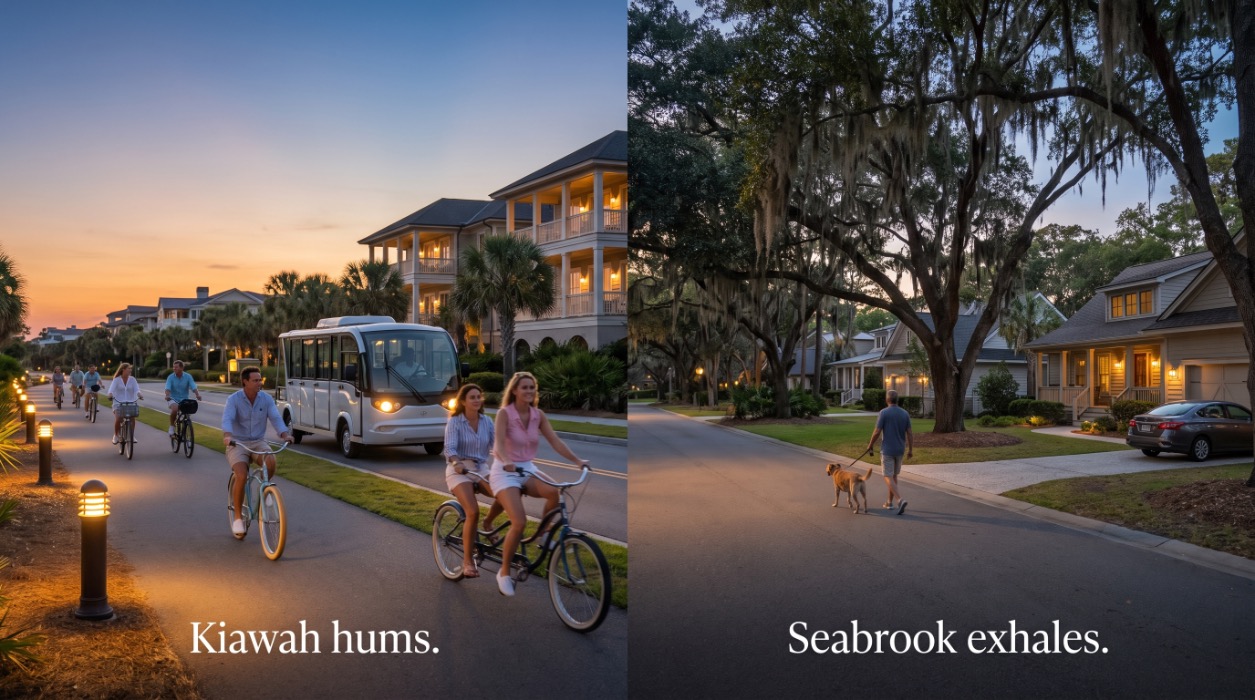
Seabrook Island vs. Kiawah Island—same latitude, radically different vacations. Kiawah buzzes with championship golf, resort shuttles, and ten miles of bike-able beach. Seabrook whispers: sunrise horses, off-leash dogs, and quiet residential streets. Over the next twelve sections, we’ll compare verified 2026 prices, amenity-gate rules, flood risk, and buying costs so you can choose the island—and booking channel—that fits your trip or second-home plans with zero surprises. First up: what your lodging costs once every hidden “amenity” fee lands on the bill.
AI Generated image
Beaches: more miles or more hush?
Shoreline length and room to roam
Kiawah unfurls ten miles of Atlantic sand, enough to jog for an hour without turning around or to bike a full-length beach loop, according to the Kiawah Island Golf Resort.
Seabrook offers 3.6 miles of shoreline, shorter, but it sits behind one residential gate and carries far fewer rental beds, so even July high tide feels almost private, reports the Seabrook Island Property Owners Association.
Quick takeaway: distance lovers pick Kiawah; solitude seekers lean Seabrook.
Public versus private entry
Beachwalker Park is Kiawah’s only full public access. Its 150-space lot often fills by mid-morning in summer; pay $5–$25, roll your cooler down the boardwalk, and you’re on the same sand as resort guests.
Every Seabrook boardwalk starts inside the gate; guards check rental or owner lists. No rental, no pass, no sand. The payoff once inside is a Bluetooth-free hush and empty shoreline photos without cropping strangers.
Safety and accessibility
- Kiawah posts seasonal lifeguards, ADA parking, a ramped boardwalk, and free beach-wheelchair loans at Beachwalker.
- Seabrook labels Boardwalk #1 and #9 accessible for registered guests, but the island runs no community-wide lifeguard patrol; parents become the watch.
If you need flagged swim zones and on-duty guards, Kiawah wins. If your dream day is wave-listening silence, Seabrook delivers; just secure that gate pass first.

Allan Nygren/Unsplash
Golf: five resort courses versus two private classics
Course lineup and how to get on the tee sheet
Kiawah is built around golf. Five resort courses (the Ocean Course plus Osprey, Turtle, Cougar, and Oak Point) let resort guests lock in prime tee times months ahead; public players can book, but only inside a shorter window.
Seabrook counters with two distinct layouts (Crooked Oaks, designed by Robert Trent Jones Sr., and Ocean Winds, designed by Willard Byrd and recently renovated by Rees Jones) inside a private club. You need a rental that includes an active club membership to play; no pass, no golf.
Winner on volume and ease: Kiawah. Seabrook works only if your lease guarantees tee rights.
What it costs to play (and the caddie math)
| Course | 2026 resort guest green fee | Caddie/cart policy | Source |
| Ocean Course | Approximately $600 to $685 depending on season and guest status | Walking-only; caddie recommended gratuity $120 pp; forecaddie with cart $60 pp | Kiawah Island Golf Resort |
| Osprey, Turtle, Cougar, Oak | $180 to $315 depending on season | Cart optional; rental clubs $85 | Kiawah Island Golf Resort |
| Crooked Oaks & Ocean Winds | $185 to $245 for 18 holes, plus a $35 cart fee (with active amenity pass) | Cart fee noted; no caddie program | Seabrook Island Club |
Math check: An Ocean Course round in peak spring costs roughly $600 green fee + $120 caddie tip = $720 before drinks. The same date at Seabrook, if you have access, may land under $280.
If your group prizes PGA pedigree, splurge on Kiawah. If you value pace of play over headlines, and you’ve secured written Seabrook access, you can save a few hundred dollars per player across a long weekend.

Raphael Biscaldi/Unsplash
Pools and family programming: more splash on Kiawah (when the pass is included)
Filtering for properties that already bundle club access can save families $25 to $50 per person per day in pool fees. SkyRun Vacation Rentals lists Kiawah and Seabrook villa rentals with a prominent “amenity card included” badge, letting you see the fully loaded options in seconds.
Where the kids cool off, and parents catch a break
Kiawah. Book directly with Kiawah Island Golf Resort and your key card opens two resort pool complexes:
- Night Heron Park: activity pool, splash zones, and slide tower.
- West Beach Village: lazy-river-style pool with zero-entry areas.
Naturalists host daily nature walks, gator talks, and tie-dye sessions nearby. Private Airbnb guests do not receive wristbands, so confirm access before promising the kids a slide.
Seabrook. The island trades volume for views: two ocean-front pools at the Beach Club (seasonal March 12–Nov 1, 2026), plus an indoor lap pool and kids’ splash pad at the Lake House. Access rides on the owner’s electronic amenity card; most summer rentals include it, but offseason deals sometimes don’t.
Bottom line: Kiawah wins on splash factor and structured kids’ programs if you book through the resort. Seabrook delivers quieter pool decks and postcard sunsets, provided your lease includes the Club pass.
Coen Van De Broek/Unsplash
Biking, racquet sports and horseback riding
Kiawah’s biking advantage
Kiawah threads more than 30 miles of paved leisure trails plus 10 miles of hard-packed beach, enough for a traffic-free island loop under moss-draped oaks. Resort guests reserve bikes online and find them waiting at the villa door; private renters use outside vendors but can’t rent the resort-branded fleet.
Fitness riders log 15 pre-breakfast miles; casual guests trade car keys for sunset ice-cream runs. On Kiawah, wheels rule.
Seabrook’s ride and its horses
Seabrook’s paved main road forms roughly a six-mile loop, with an 11.2-mile suggested route in the guest guide, shorter and shared with local traffic, so young riders need extra care. The payoff arrives on the sand: an almost empty beach ride at dusk.
Bikes share top billing with saddles. The Seabrook Island Equestrian Center offers guided forest trails and, when tides allow, memorable beach trots. Facilities include 42 stalls and three miles of marked trails; riders must be at least eight years old and under 240 lb, and advance reservations are required.
Racquets on both islands
- Kiawah: Governor’s Club guest schedule lists $41 per court-hour for tennis and pickleball, and $82 for padel.
- Seabrook: Court time rolls into the amenity pass, no extra fee, but prime summer slots vanish fast.
Verdict: Long-distance cyclists and mileage fans lean toward Kiawah, while horse lovers and sunset cruisers favor Seabrook—as long as they secure the right pass or saddle slot early.

Nrd/Unsplash
Dining, groceries and nightlife: feed me, don’t thrill me
One shared village, two dinner strategies
Both islands orbit Freshfields Village, home to 13 eateries, 50-plus shops, a 6 am–11 pm Harris Teeter, and a full-service pharmacy. Whether you stay on Kiawah or Seabrook, you’ll stock the fridge, grab lattes, and end the night with gelato here.
Kiawah: add resort restaurants to the mix
If you’re on Kiawah and booked through the resort, you can layer in:
- The Ocean Room, a white-tablecloth steakhouse with a 1,000-label wine list.
- Jasmine Porch for Lowcountry shrimp-and-grits with sea-breeze views.
- Ryder Cup Bar overlooking the Ocean Course’s 18th green.
Villa guests booked outside the resort can still call for lunch, but peak-hour dinner slots favor amenity-card holders.
Seabrook: club sunsets and marina grills
Seabrook’s lineup is smaller and tied to the amenity pass:
- Pelican’s Nest: open-air seafood on the dunes.
- Bohicket Lounge inside the Island House for rainy-day burgers and golf-course views.
- Seasonal taco or oyster nights poolside at the Beach Club.
Outside the gate, Bohicket Marina adds a handful of casual waterfront grills within an easy bike ride.
Nightlife reality check
Expect patio music at Freshfields, wine dinners at the clubs, and a sunset stroll with ice cream. For late-night bars or DJs, plan a downtown Charleston run, or split the trip.
Verdict: Kiawah wins on volume and variety; Seabrook satisfies if oceanfront sunsets and a quiet drink beat course-view fine dining.

Towfiqu Barbhuiya/Unsplash
Privacy and overall atmosphere: resort pulse versus residential hush
How each island feels once the gate clicks shut
Kiawah hums. Resort shuttles loop between villas, bikes share more than 30 miles of pathways, and up to 150 day-visitors a day enter through Beachwalker Park’s public lot. The energy feels curated, not chaotic; think “boutique resort village” instead of a mega strip. You’ll notice a steady, sociable rhythm from dawn tee times to post-sunset ice-cream runs.
Seabrook exhales. Clear the single security gate and traffic falls to a whisper. Boardwalks reach only registered addresses; with no public beach park, passer-by flow is almost zero. Even in July, you’ll recognize the same dog walkers by day two and hear cicadas louder than car engines after dark. The trade-off: teens craving nightlife or golfers wanting a bar scene after 9 pm may grow restless.
Security mirrors the mood. Kiawah layers access with a public beach, resort zones, and then residential gates, so crowds thin as you move inland. Seabrook sets one firm line at its gate, keeping the interior purely residential. Choose the tempo that suits you: resort buzz or private coastal hush.

Oscar Sutton/Unsplash
Pets and mobility access: tails, wheels and real-world ease
Seabrook’s dog-friendly edge
Seabrook’s town code lets pups run off-leash all day October 1–March 31 and before 10 am / after 5 pm from April 1–September 30 in the General Beach Zone.
Kiawah allows dogs year-round, but leashes stay clipped inside Beachwalker Park. A designated Dog Use Area (between the Beach Club and Ocean Course) permits off-leash play year-round from 7 am to 7 pm. On the rest of the beach, dogs must be leashed March 16–October 31, and may be off-leash from 7 am to 7 pm November 1–March 15.
Public ADA facilities lean Kiawah
Beachwalker Park provides accessible parking, a ramped boardwalk, restrooms, and free beach-wheelchair loans, giving day-trippers reliable infrastructure.
Seabrook lists Boardwalk #1 and #9 as accessible and offers wheelchairs via the Lake House, but you must clear the residential gate and schedule pick-up first—an extra step for visitors who rely on rolling access.
Takeaway: Off-leash freedom and quieter sand favor Seabrook, while ready ADA amenities favor Kiawah’s public Beachwalker Park.
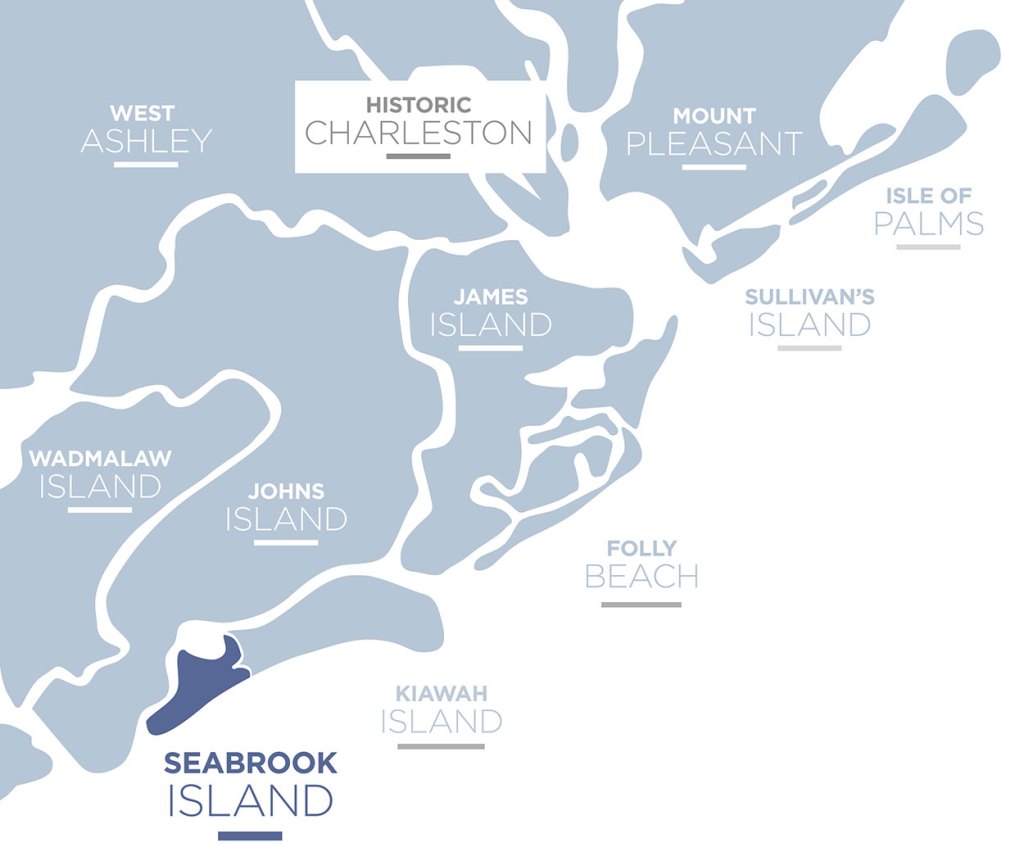
Map courtesy of ExploreCharleston.com
Charleston airport and medical access: the practical miles
Getting there and back without blowing a beach day
Charleston International Airport (CHS) sits about 32 miles from the Kiawah gate and 33 miles from Seabrook’s gate, roughly 45–55 minutes without traffic. Add 30 minutes on summer Saturdays, after-work Fridays, or during thunderstorms; Johns Island’s two-lane corridor backs up fast.
Once you arrive
You will want a car. Kiawah’s resort shuttle moves only eligible resort guests between on-island amenities; it doesn’t reach Freshfields or Charleston. Seabrook offers no island-wide transit beyond occasional event shuttles. Bikes handle short hops, but groceries, golf bags, and midnight pharmacy runs still need four wheels.
Medical and everyday services
- Freshfields Village hosts Roper St. Francis Primary Care, a pharmacy, and an urgent-care clinic, about 10 minutes from either gate.
- Serious emergencies route to MUSC or Roper downtown Charleston, 50–70 minutes depending on traffic. Travelers with chronic conditions should keep meds on hand and consider trip insurance.
Dining in downtown Charleston
Locals clock the round-trip at 45 minutes on a quiet night, 75-plus on a summer Friday. If Husk or FIG tops your list, aim for lunch or book a downtown night at the beginning or end of your trip.
Bottom line: build buffer time into both arrival and departure, keep a car, and treat Freshfields as your hub for everyday needs.
Vu Anh/Unsplash
Buying a second home: sticker shock versus ongoing costs
First look at purchase prices and annual assessments
Kiawah sits at the top of the Lowcountry price ladder. The island’s 2025 year-end market report lists a single-family median of $3.4 million; many oceanfront estates sell higher. Villas start in the high six figures but still carry a prestige premium.
Seabrook begins lower. As of spring 2026, the average home value on Seabrook Island has officially surpassed $1 million, with cottages and townhomes regularly closing under $1 million.
Annual community assessments barely differ: $3,158 for an improved Kiawah property vs. $3,133 for a developed Seabrook lot. Add regime fees on many villas, plus flood and wind policies that climb the closer you build to the surf, and the yearly gap narrows fast.
Both islands levy a 0.5 percent capital contribution at closing. Kiawah adds a $100 administrative fee; Seabrook charges $250.
Snapshot: Seabrook wins on sticker price; ongoing costs pull the two closer together.
The club-membership wrinkle that flips the “cheaper” script
- Seabrook: Buyers who didn’t own pre-2005 must join the Seabrook Island Club. Initiation runs about $15,000 for Social to $75,000-plus for Full Golf, with annual dues on top.
- Kiawah: The private Kiawah Island Club is pricier—roughly $120,000–$185,000 depending on tier—but remains optional for most addresses. You can buy a $1-million villa and skip the club entirely, paying for resort golf and dining à la carte.
Translation: Seabrook looks cheaper until you add mandatory club dues; Kiawah looks pricier until you realize you can avoid its private club completely. Always request a written dues schedule for the exact street and regime before falling for the view.

Jakub Zerdzicki/Unsplash
Rental rules and income potential: the fine print that funds (or flattens) cash flow
Kiawah’s brand premium and clearer data
AirDNA’s dashboard shows approximately 604 active Kiawah listings, a $653 average daily rate, and $48.5 K median annual revenue for a typical two-bedroom villa. Supply depth makes comps relatively easy, and town rules are straightforward: noise limits, two people per bedroom plus two, and standard parking caps. Investors focus on marketing and amenity access rather than permit lotteries.
Seabrook’s tempting (but murky) numbers
Town data reports 603 “Seabrook” short-term-rental permits at a $199 ADR; Rabbu’s scrape shows fewer than ten. The gap comes from loose geo-fences that pull in mainland Johns Island addresses. Until you export and review each listing, any ADR or occupancy average is suspect.
Regulation: looser vs. tighter
- Kiawah: Annual business license, good-neighbor rules, and no island-wide cap on STR permits.
- Seabrook: Mandatory license renewal, online portal tracking head count and gross receipts, 24-hour local contact, posted rules, and fast penalties for violations.
Lesson: Kiawah wins on data clarity and recognized brand demand. Seabrook may deliver higher net yield only after you vet true comps and budget for the annual $6,300 rental-guest amenity fee that owners pay the club to let guests use pools and golf. Skip that homework and you’re guessing, not projecting.

Kelly Sikkema/Unsplash
Flood risk, infrastructure and ecology: barrier-island reality check
Neither island is risk-free, but one publishes its homework
Both Kiawah and Seabrook sit on the same shifting strand, absorbing Atlantic storms and king-tide pulses. NOAA’s Charleston tide gauge shows a long-term relative sea-level rise of 3.51 mm per year, about 1.15 feet per century.
Kiawah: line-item transparency
Kiawah Island Community Association’s 2026 budget earmarks about $1 million for annual drainage-pipe replacements, plus funds for pond dredging and boardwalk rebuilds. Buyers can read the spreadsheet before closing.
Seabrook: zoning and buffers, fewer hard numbers
Seabrook’s 2024 Comprehensive Plan flags rainfall flooding, tidal flooding, and compound surge from storms like Irma as top risks. It leans on stricter elevation rules, natural buffers, and incremental boardwalk or bulkhead work, but publishes fewer dollar figures, so due diligence falls to the buyer.
Ecology: different gold stars
- Kiawah: turtle-season lighting rules, single-use-plastic ban at beach concessions, Audubon-cooperative golf on select courses.
- Seabrook: both golf courses are Audubon-certified, and the dog-zoning plan balances off-leash fun with nesting shorebirds.
Call it a draw—one that still relies on visitors filling in sand holes, packing out trash, and dimming porch lights.
Tom Winckels/Unsplash
Which island should you choose?
Use this quick-glance table to match your top priority to the island that solves it.
| Traveler or buyer profile | Better fit | Key reason |
| Serious golf group | Kiawah | Five resort courses and easier tee access |
| First-time luxury family | Kiawah (book through resort) | Pools, kids’ programs, and a shuttle; no amenity gaps |
| Quiet multigenerational stay | Seabrook | Single residential gate, sunset deck dinners, easy driveway parking |
| Dog-focused vacation | Seabrook | Longer off-leash windows (Oct 1–Mar 31 all day) and fewer crowds |
| Horse lover | Seabrook | Guided beach and forest rides from the 42-stall equestrian center |
| Long-distance cyclist | Kiawah | 30-plus miles of paved trails and 10 miles of hard-packed beach |
| Public beach day-tripper | Kiawah | Beachwalker Park is the only public gate |
| Budget-minded second-home buyer | Seabrook | Lower median purchase price (≈ $1 M+ vs. ≈ $3.4 M) |
| Buyer avoiding mandatory dues | Kiawah (outside club-required enclaves) | Private club optional for most addresses |
| Nightly Charleston foodie | Split stay | Overnight downtown, then island wind-down |
Treat the table as a compass, not a verdict. If your group spans multiple boxes (for example, golfers with dogs), prioritize the factor that would cause pain if ignored. You can drive to off-island courses, but your dog can’t negotiate leash hours.
Pre-booking decision checklist
Run through these ten questions before you swipe the card, and you’ll sidestep 90 percent of island-rental surprises.
- Access: Does the lease include pool, golf, and club-dining privileges for every guest, adults and kids?
- Boardwalk distance: How far (in feet or minutes) is the nearest usable beach boardwalk, and are there stairs or elevator delays?
- Mobility & bikes: Will beach bikes roll straight from the driveway, or will you load them into the SUV each ride?
- Pet rules: What are the exact leash windows for your travel week, and does the host allow pets inside the unit?
- Green-fee math: What will you pay on your exact dates for green fees, caddie tips, cart rentals, and club hire?
- Closures: Are any pools, restaurants, or kids’ programs closed or on reduced hours during your stay?
- True nightly cost: Do the quoted rates include cleaning, platform, and amenity fees, or will they surface at checkout?
- Insurance: Have you added travel insurance that covers hurricanes, medical events, and non-refundable tee times (June 1–Nov 30 hurricane window)?
- Emergency contact: Who is your 24-hour local contact for maintenance or medical issues, and how fast can they reach the property?
- Drive time: Check real-time GPS from CHS to the front gate for your arrival hour (holiday Fridays can add 30–40 minutes).
Check every box and you’ll prepare better than most travelers—and even a few new homeowners.

Laurin Steffens/Unsplash
Frequently asked questions
Is Seabrook Island more private than Kiawah?
Yes. Seabrook has a single residential gate and no public beach park, so only owners and registered guests reach the sand. Kiawah, by contrast, includes Beachwalker Park, a 150-space public access lot, plus resort zones and private neighborhoods.
Which island is cheaper for a summer rental?
Historically, advertised nightly rates run about $100–$200 lower on Seabrook, but only when the rental includes an amenity card. A “bargain” villa without pool access can turn costly once you add day-pass fees or activity charges.
Do Kiawah vacation rentals include resort pools?
Only bookings made directly with Kiawah Island Golf Resort (or homes enrolled in its program) unlock Night Heron and West Beach pool complexes. Most Airbnb or VRBO listings do not come with wristbands.
Do Seabrook rentals include Beach Club access?
Many do, some don’t. Look for “amenity card included” in the listing, and confirm in writing that the card covers pools, golf, and dining for every guest.
Can the public visit Seabrook’s beach for a day trip?
No. Without a rental, resident invitation, or club event, visitors are turned around at the gate.
Which island is better for dogs?
Seabrook. Dogs may run off-leash all day October 1–March 31 and before 10 am / after 5 pm April 1–September 30 in the General Beach Zone. Kiawah permits off-leash play year-round from 7 am to 7 pm in a designated Dog Use Area, and island-wide (except critical habitats) from November 1–March 15, but never inside Beachwalker Park.
How far are the islands from downtown Charleston?
Expect 40–70 minutes each way depending on traffic; Friday summer evenings can exceed an hour. Real-time GPS beats any static estimate.
Is one island safer from flooding?
Both are barrier islands exposed to rain, tide, and surge. Kiawah publishes line-item drainage budgets (about $1 million in 2026); Seabrook relies more on zoning and natural buffers. Your lot elevation and FEMA zone matter more than the island name.