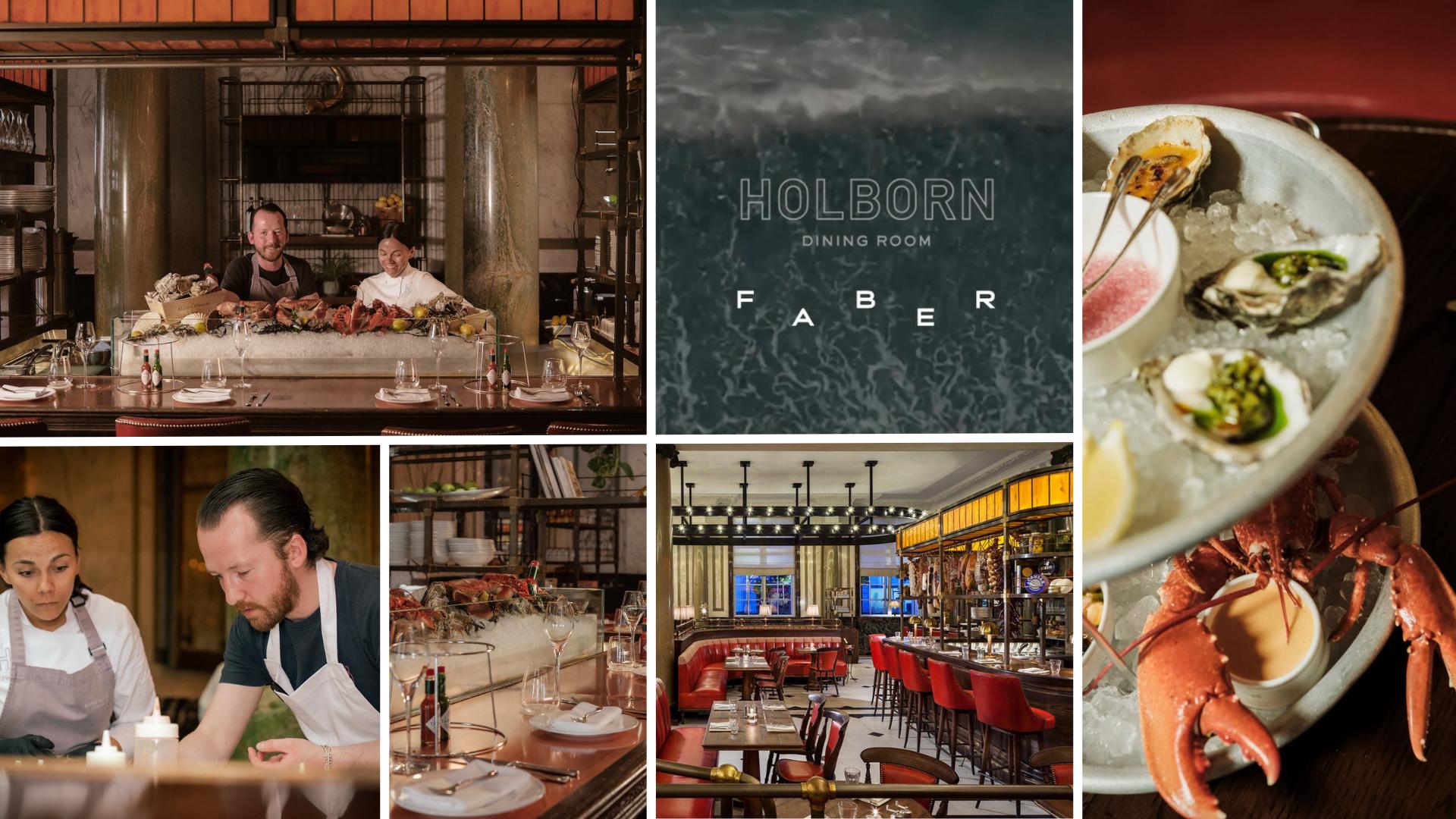
In a hall built to insure lives and fortunes, a tide has crept in. At Rosewood London’s Holborn Dining Room, Chef Ollie Bass has brought his Hammersmith restaurant, Faber, inland for a limited residency, turning the city’s armoured heart towards the sea. Across the room, the hotel’s own sommelier, Romain Barina, anchors the wine.
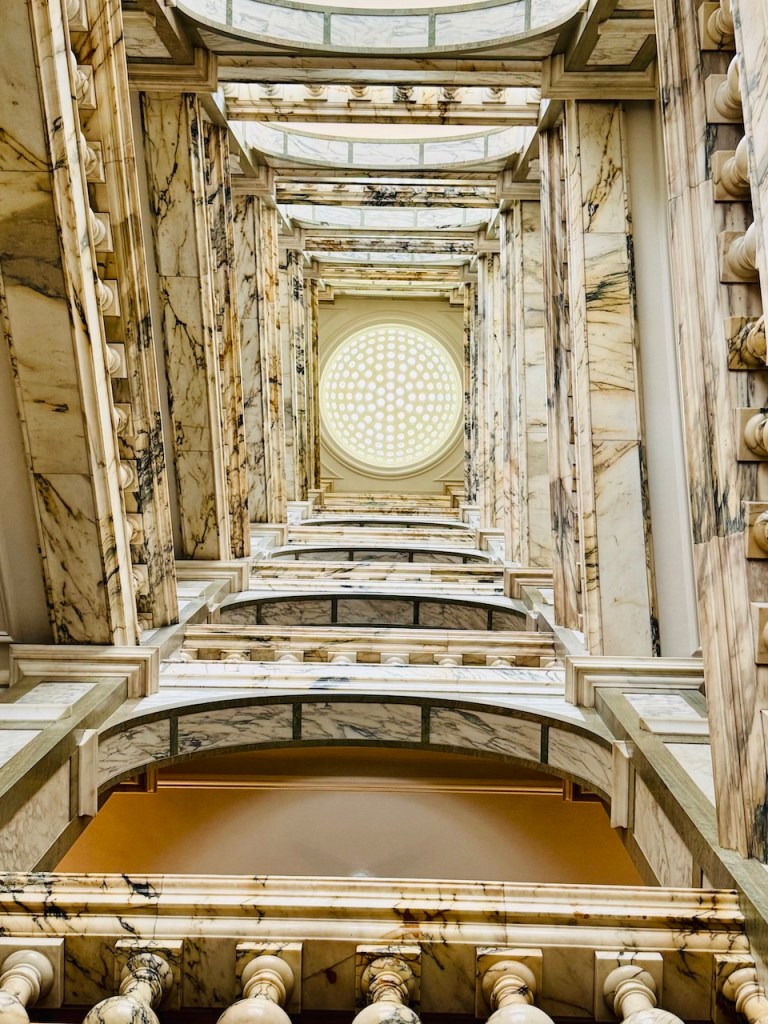
At 252 High Holborn, the former Pearl Assurance headquarters is Edwardian permanence carved into materials: seven kinds of polished marble, Cuban mahogany, a Renaissance staircase curling beneath a 166-foot cupola. Many guests, heading for the lifts, will never see it, hurrying past its deliberate weight. Yet this is a building designed to make law and money look immortal, as if mortality itself could be amortised. Even after restoration, it feels less like a hotel and more like a vertebra in the city’s skeleton, holding statute, currency, and the illusion of continuity in place.
Holborn Dining Room inhabits what was once the East Banking Hall, and the room has not forgotten. Mirrored, brass-lit, with a ceiling that enforces posture, it has long been known for pies prepared with ecclesiastical care—but now a narrow run of ice and shell cuts through the marble like a fault line, as if a fragment of coastline had pressed itself against the building.
The counter is a stage where shells catch the light and a breath of brine drifts over the brass. It belongs, for now, to Ollie Bass—a name which sounds appointed rather than chosen—executive chef of Faber, the Hammersmith restaurant that has become one of London’s clearest voices on fish. This is his residency: Faber transplanted for the summer. Bass’s cooking is disciplined without austerity, carrying a rigour beneath its calm. His time at Quo Vadis and Sessions Arts Club gave him technique; Faber gave him a shoreline to chart.
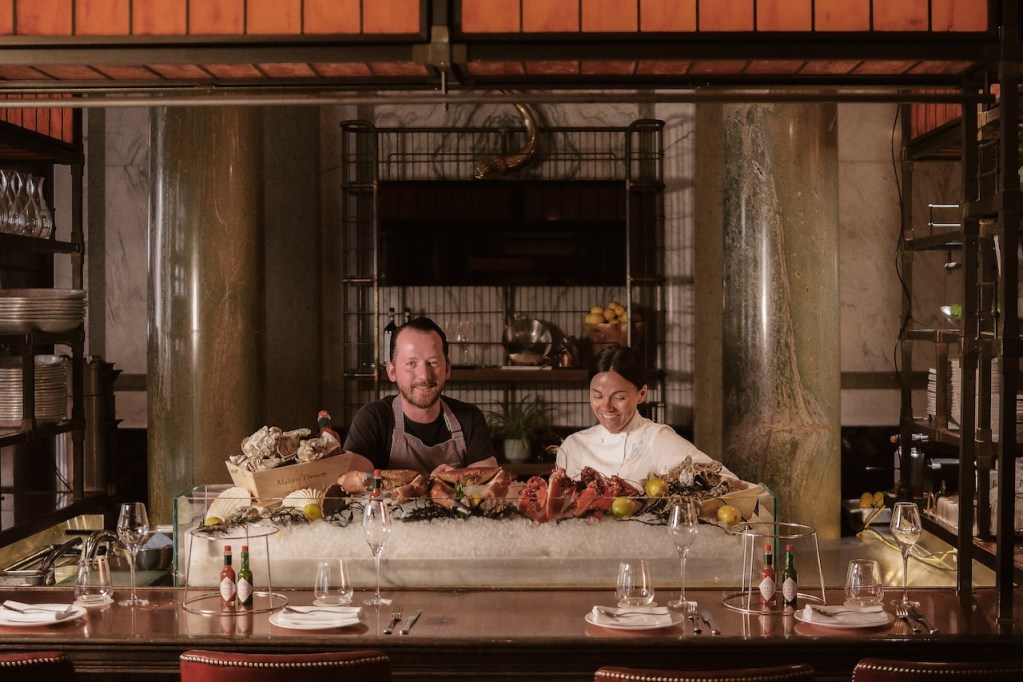
A Counter with Consequence
Here, working alongside Holborn’s head chef, Ilona Perczyk, Bass has mapped Britain’s edges. The menu reads like a compressed coastline: Welsh laverbread biscuits made with Pembrokeshire seaweed from the Câr y Môr community farm; Maldon oysters brushed with rhubarb mignonette or served with a drift of crème fraîche and torched Sussex do’ya, a coastal echo of nduja with a subtle, smoky heat; hand-dived Devon scallops under smoked dashi and yoghurt, tasting of cold water and nerve; from the famed pie room, a pastry lid concealing Pembrokeshire lobster; Dorset crab balanced on aged Cheddar biscuits, the shore distilled into a single bite; John Dory with smoked eel and broad bean, carrying St Peter’s thumbprint, paired with a Kentish Chardonnay drawn taut as a line in sand.
Beyond the Faber dishes, Holborn keeps its own signatures: the Clarence Court Scotch egg and the Hereford beef tartare. The Scotch egg—rightly award-winning—is a dish born of pubs and picnics, here becoming a tether between familiarity and grandeur. The tartare is its cooler counterpart, Hereford beef worked just enough to yield tenderness without losing the echo of pasture.

Wine remains in the hands of Romain Barina, Holborn’s core sommelier, whose path runs from his family’s Czech vineyard—which he will return to for harvest—through Maze Grill in Hong Kong, and in London, the Connaught Grill, Galvin Restaurants, Claridge’s and 45 Park Lane before arriving here. His pairings are measured, built to reflect chalk and edge without overshadowing them, shaped by years in rooms where restraint is its own discipline. He favours older bottles with character: Austrian Grüner Veltliners from Bernard Ott, Otago Pinots such as Burn Cottage, declassified Barolos like Torbido Cascina Ebreo, and taut Syrahs which carry their landscape in their bones. The list pulses with English sparkling and champagnes, fitting for a British brasserie which doubles as a discreet annex for barristers post-verdict. The gins nod to the shoreline: Devon’s Salcombe leads this month, while Cornwall’s Tarquin powers the Negroni trolley.
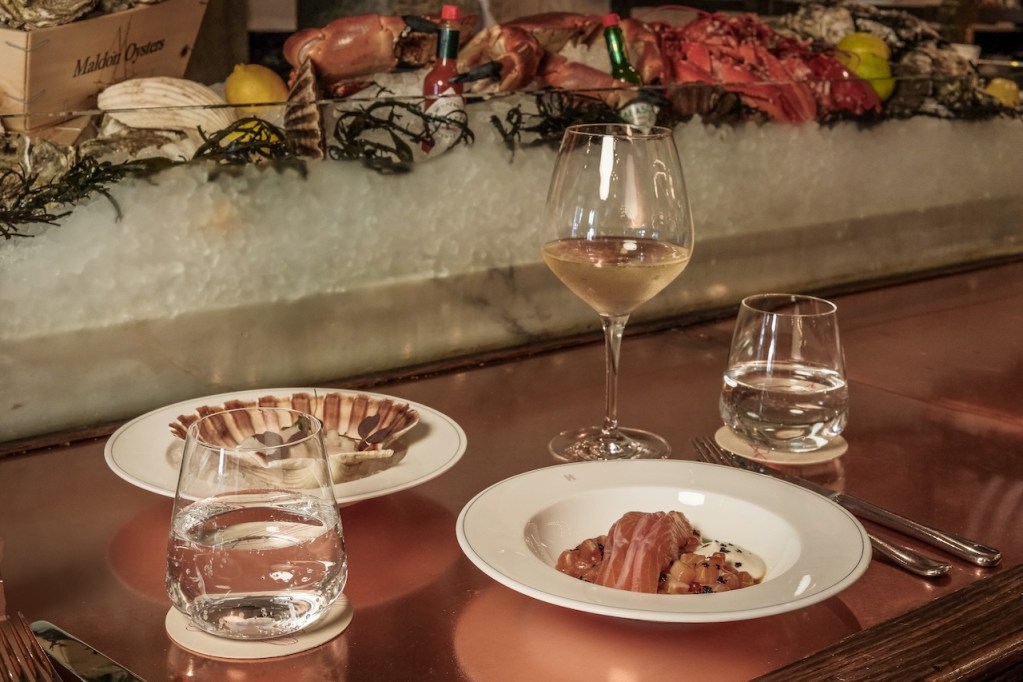
London has always been uneasy with its own boundaries. An island city which has spent centuries burying its rivers. Holborn itself was once water; the Fleet ran here before the city folded it beneath clay. London is good at erasing its shoreline, as if the sea were a minor embarrassment rather than a source. This counter doesn’t declare itself; it simply exists, a slip of shore pressed into marble, a reminder that water remembers even when you choose not to.
There is already talk of Rosewood’s new Mayfair flagship, the Chancery Rosewood, opening in the former US Embassy this autumn under David Chipperfield Architects. It will make headlines because it is new. This one doesn’t need to. High Holborn’s Rosewood is set into the city like a vertebra, holding weight without demanding notice. If you come for the oysters, look up from the counter and take the long route back through the hall. See the staircase coil under the cupola, feel the building’s deliberate weight. It is not shouting for your attention; it has been here all along.
The Seafood Counter by Faber runs as a residency at Holborn Dining Room until 14 September 2025.
To discover more, visit Holborn Dining Room
View this post on Instagram
All Image Courtesy of Holborn Dining Room.