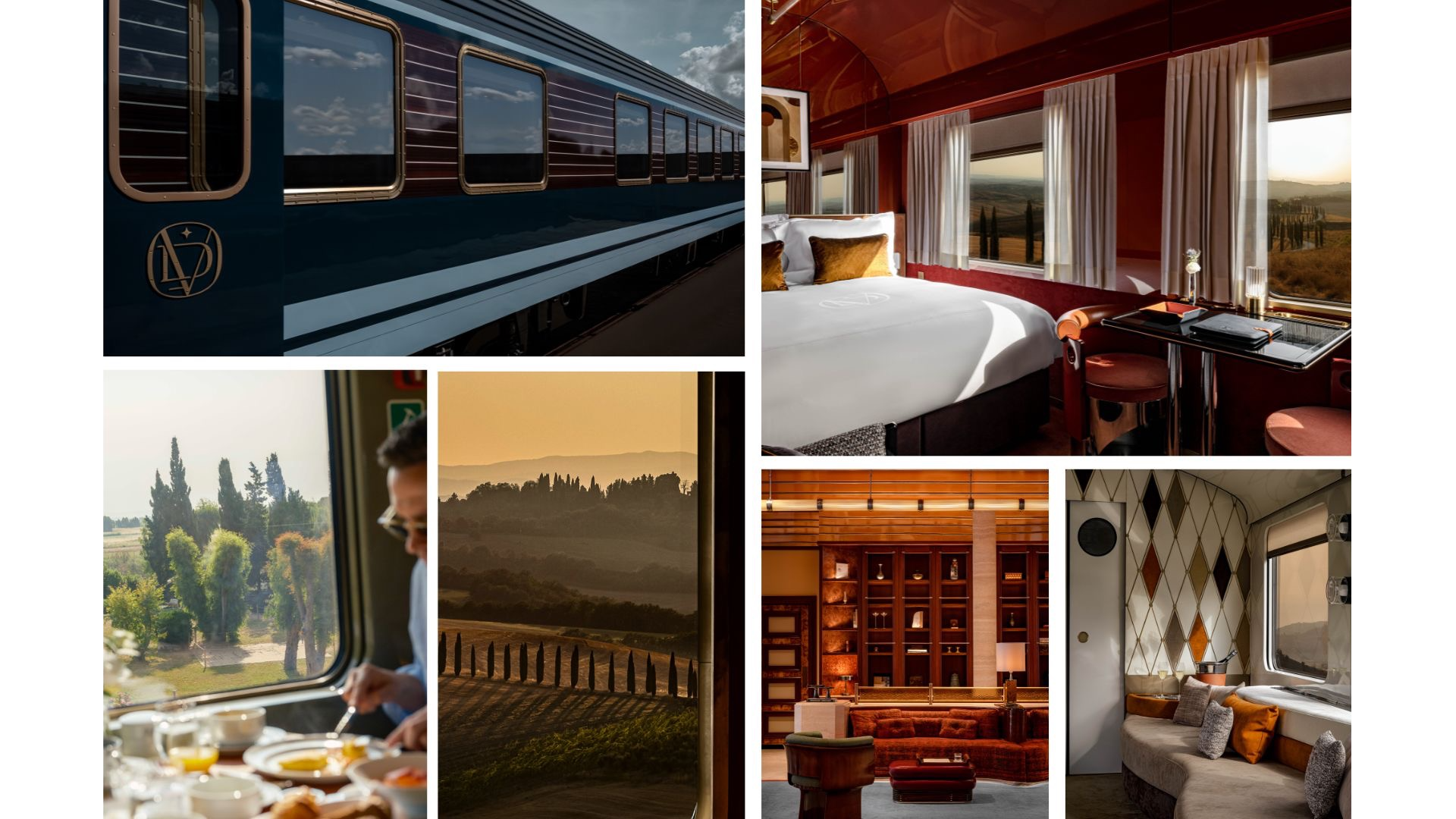
They say it’s about the journey, not the destination, but here both are spectacular bucket-list experiences on La Dolce Vita Orient Express.
It all started with a night at Orient Express La Minerva. A short drive and we were inside the La Dolce Vita Lounge at Roma Ostiense, awaiting the departure of the La Dolce Vita Orient Express, glass of something in hand. Watching the room fill gradually with fellow travellers, you start to notice something you rarely encounter in modern travel. No one is rushing. No one is restlessly checking the time. There is no sense of being processed, no friction, no urgency pressing in from the outside. There is only anticipation, and it builds gradually.
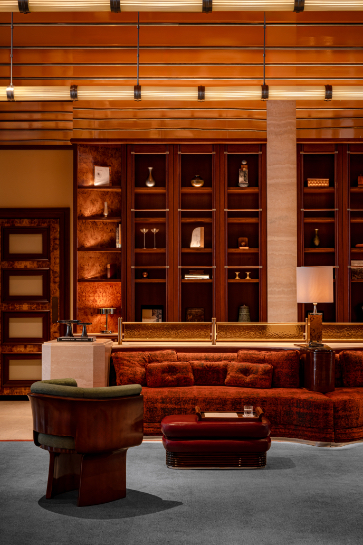
The space is designed to hold that feeling. More private members’ club than station lounge, it is layered with textured fabrics, curated Italian artworks, and warm lighting that softens the edges of departure. Conversations move easily. People linger without looking for a reason to. It feels less like the beginning of a trip and more like the beginning of a shared experience.
Check-in happens without interruption. Luggage disappears. A staff member walks you to your cabin, speaking about the train with an understated pride that feels genuine. You’re not managing anything. You’re simply there, stepping into something that has already been carefully thought through.
Because this journey does not start when the train moves. It starts when everything else stops.
A Legacy, But Not a Replica
The Orient Express name carries weight. It always has.
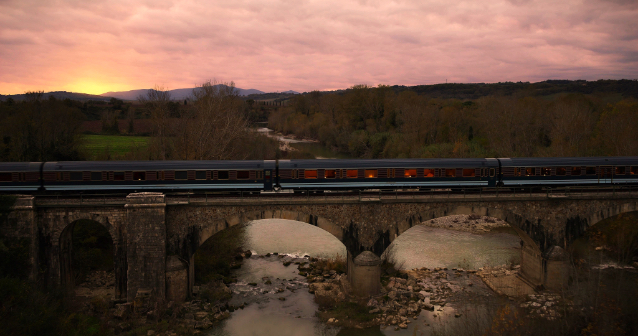
Since 1883, when the Rome-Express first connected France to Italy, it has stood for a way of travelling built on experience rather than efficiency. Time was never something to minimise. It was something to enjoy.
La Dolce Vita Orient Express understands that legacy, but it does not attempt to recreate it. Instead, it reshapes it through a distinctly Italian perspective. There is less rigidity, less ceremony, and far more instinct. The glamour remains, but it feels warmer and more human. It reflects how people want to travel now, not how they used to.
This is not nostalgia repackaged. It is a continuation that feels relevant.
That evolution is already expanding. Orient Express has introduced a five-day “Grand Tour” route across Italy, a circular journey departing from Rome and moving through Venice, Matera, Taormina, and Palermo before returning to the capital. It is a more expansive expression of the same idea, one that moves between Italy’s most distinct regions while maintaining the same level of detail and consideration. Less a single journey, more a complete perspective. It makes one thing clear. This is not a one-off revival. It is a deliberate return to a slower, more immersive way of travelling.
Why Train Travel Still Wins
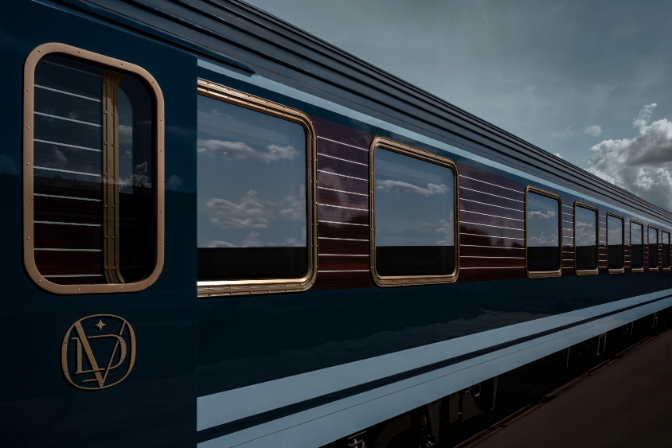
Modern travel has become highly efficient and almost entirely forgettable. Airports blur into each other. Flights compress entire countries into departure gates and arrivals halls. Duty-free selections try to convince you that you have experienced something local. You leave one place and arrive in another with very little sense of what exists between them.
Train travel refuses that.
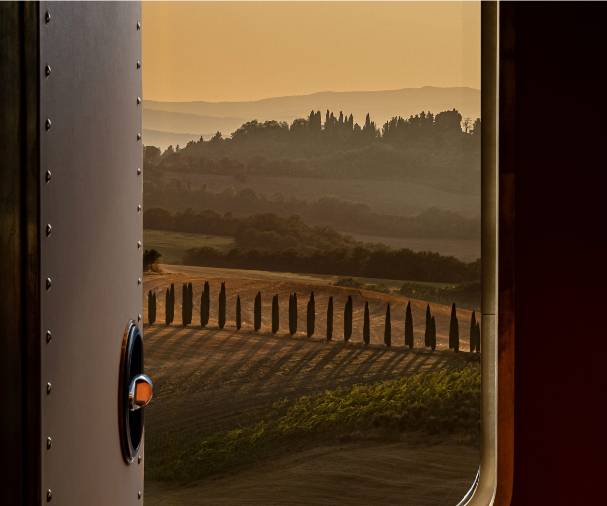
It allows distance to unfold. You see how Italy changes in real terms. Leaving Rome, the dense urban landscape gives way to cultivated countryside, rows of olive trees stretching across low hills, farmhouses scattered between them. Moving further south, the terrain tightens into mountains, and the coastline begins to appear in fragments, glimpses of the Tyrrhenian Sea cutting through the land.
You are not skipping over the country. You are moving through it, watching it reveal itself at its own pace.
Without interruptions, no security lines, no boarding calls, no artificial pauses, your attention returns to what is outside the window. The journey becomes something you experience rather than something you endure.
The Cabin: A Private Perspective
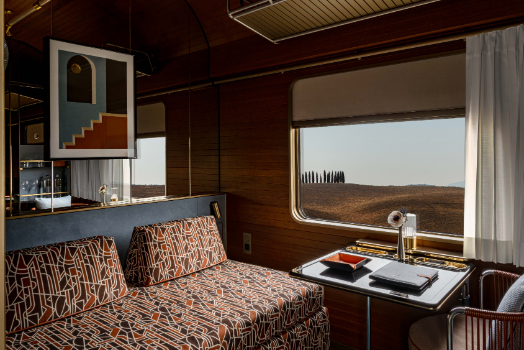
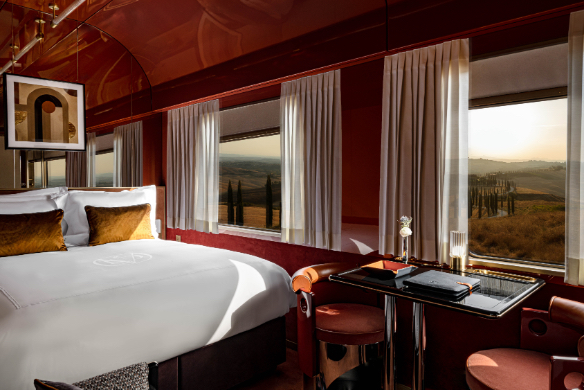
The Suite Cabin in Carriage A is where the experience becomes personal.
Created by Dimorestudio, the interiors draw from mid-century Italian design while remaining completely current. Influences from Gio Ponti and Carlo Scarpa are present in the proportions and material choices, but they are integrated with restraint.
Walnut wood, polished brass, and deep-toned textiles define the space. Mirrored panels subtly extend it, catching natural light throughout the day, while the wood-panelled ceiling brings warmth and balance.
It feels closer to a boutique hotel room than a train cabin.
The layout of the cabin is intelligently handled. The en suite bathroom, finished in marble and fully equipped, adds a level of comfort that is still rare on trains. What matters most is how easy it is to exist in the space. You don’t adjust to it. It adapts to you. Sitting by the window, watching the landscape unfold uninterrupted, becomes one of the most memorable parts of the journey.
Amenities are ultra-luxurious and begin with the most elegant slippers. Not just any slippers. Friulian slippers were originally used in the Friulian countryside during the 19th century. The sole was made from old bicycle or carriage tyres, while the upper was sewn from fabric scraps, often taken from discarded clothes.
An important moment in the spread of Friulian shoes came when Venetian gondoliers adopted them. Their rubber soles were ideal because they did not damage the gondolas’ surfaces and allowed the gondoliers to move silently. Friulian slippers acquired a special charm, linking them to the lagoon culture.
These Friulian velvet slippers represented the essence of Italian craftsmanship and luxury. Each pair was handmade with meticulous attention to detail, using only the finest materials. Every element was carefully considered, reflecting the exceptional level of thought and craftsmanship that went into their design.
During the night, the train moved gently through the Italian terrain and rocked us to sleep. The sound and rhythm of the train became the norm straight away.
Dining: A Moving Expression of Italy
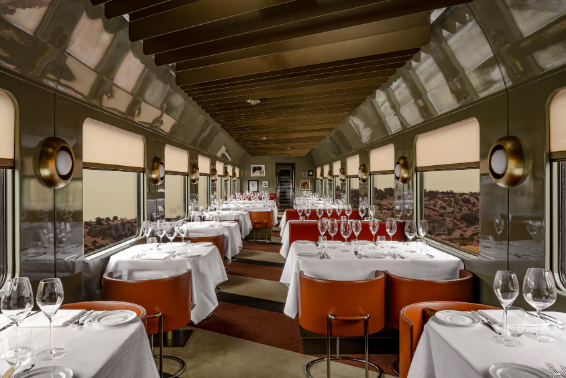
Dining aboard the train is one of its strongest components, and one of the clearest reflections of its identity.

Menus are overseen by three-Michelin-starred chef Heinz Beck, whose approach to Italian cuisine has long balanced precision with restraint. His involvement is not just a name attached to the experience. It shapes how the journey is understood through food.
Each menu is built around the route itself. Dishes evolve alongside the landscape, creating a progression that mirrors what unfolds beyond the window. It is less about complexity and more about clarity, translating regional identity into something tangible and recognisable.

Breakfast sets the standard early. Fresh pastries arrive with the kind of simplicity that only works when the ingredients are right. A savoury brioche with caponata and salted ricotta, enjoyed while passing through Sicily, feels rooted in place rather than generically Italian.
As the train moves south, the menu evolves with it. Seafood becomes more prominent. Citrus appears more frequently, sharper and more aromatic. Dishes become cleaner and more direct, allowing the ingredients to speak without interference.
At lunch, plates like gnocchetti with cacio e pepe and herb foam feel considered but not overworked. By dinner, the experience deepens, Fassona beef tartare with hazelnuts and Castelmagno reflecting northern traditions on other routes, while here the focus leans into the generosity and depth of southern Italian cuisine.
Everything is sourced seasonally and grounded in regional tradition, interpreted with a contemporary sensibility that never feels forced. It is food that understands where it comes from.
Wine follows the same philosophy. Labels are drawn from across Italy’s most respected vineyards, selected to complement not just the dishes, but the regions they represent.
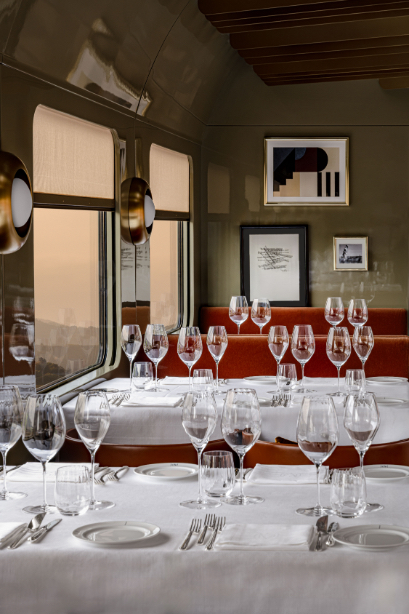
Looking out of the window and recognising elements of what is on your plate creates a connection that is rarely achieved in travel dining.
You are not just eating well. You are moving through Italy, one course at a time.
The dining car reinforces this without overstatement. Linen-covered tables, soft lighting, and a layout that allows for both privacy and conversation. It feels like a restaurant you would choose, not one you happen to be in.
Dinner is never rushed. Courses arrive with the right spacing, conversations stretch, and the atmosphere settles into something unforced. Live music moves effortlessly through the space, never dominating, but adding just enough presence to carry the evening forward.
That alone sets it apart from most luxury experiences, where even the finest meals still feel scheduled. The menu portrays sophistication with every dish, embracing the generosity found only in southern Italy. Plates arrive with a kind of quiet confidence. Uncomplicated at first glance, but deeply considered in flavour and balance. There’s a warmth to the cooking, eliciting a sense of abundance that feels both indulgent and familiar.
The Bar and the Evenings
Evenings take on their own rhythm.
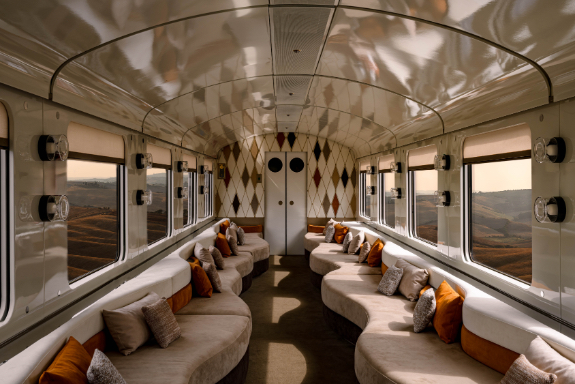
The Wagon Bar becomes the natural centre of activity, not because it is the only option, but because it draws people in. Aperitivo is handled with true Italian charm. A well-balanced Negroni, a cold Martini and good times are the order of the evening.
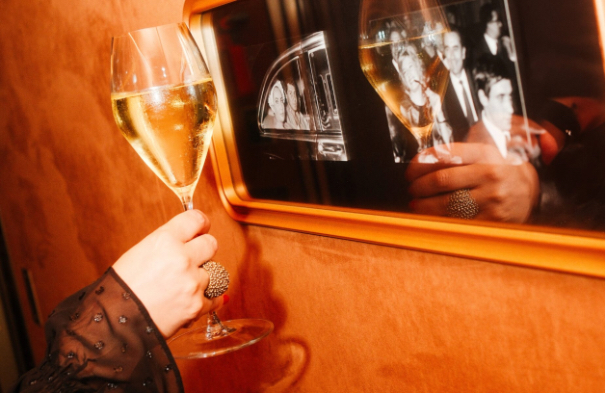
Conversations begin casually and tend to last longer than expected. You find yourself speaking to people you would not normally meet, staying for another drink without planning to.
Live music sits in the background, shaping the atmosphere without taking control of it. We had a talented group of musicians serenading us for two nights, and as the evening went on, it really felt like a moment in time that we will never forget.
At some point, it registers how unusual the situation is. Sitting on a moving train somewhere between Italian regions, drink in hand, with no immediate plan and no need for one.
It feels cinematic, but it is entirely real.
The Route
Only after settling into life on board does the full impact of the route reveal itself.
Departure from Rome happens in the morning, and within a few hours, lunch establishes the pace for what follows. By mid-afternoon, the train reaches Maratea, a coastal town in Basilicata that feels removed from Italy’s more predictable destinations.
Set between steep mountains and the Tyrrhenian Sea, Maratea unfolds across narrow streets, stone buildings, and terraces overlooking the coastline. It feels self-contained, shaped more by geography than by tourism.
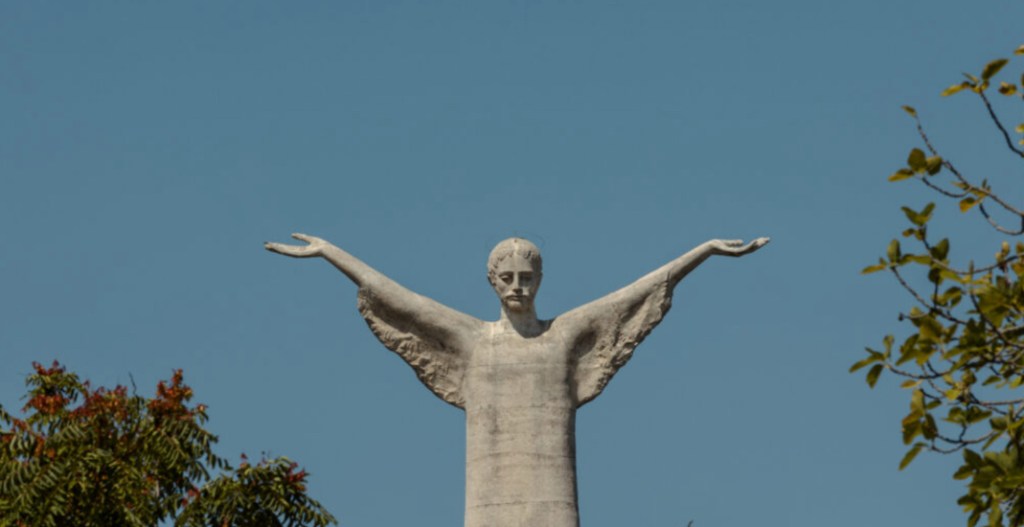
The “Under the Redeemer” experience begins with an ascent to Monte San Biagio, where the Cristo Redentore statue stands 650 metres above sea level. From here, the coastline stretches in full view, cliffs dropping into deep blue water, small beaches tucked into the landscape below.
The visit continues to the Basilica of San Biagio, where the experience turns inward. The architecture is simple, the interior marked by frescoes and subtle detail, offering a more reflective counterpoint to the openness of the landscape.
There is also a strong culinary element woven into the experience. Tastings of regional dishes introduce Lucanian cuisine in a way that feels grounded and direct. For those wanting to go further, the culinary atelier at Santavenere offers a more immersive perspective, moving beyond tasting into technique and tradition.
Returning to the train, the evening unfolds naturally, carrying through dinner, the bar, and into the night.
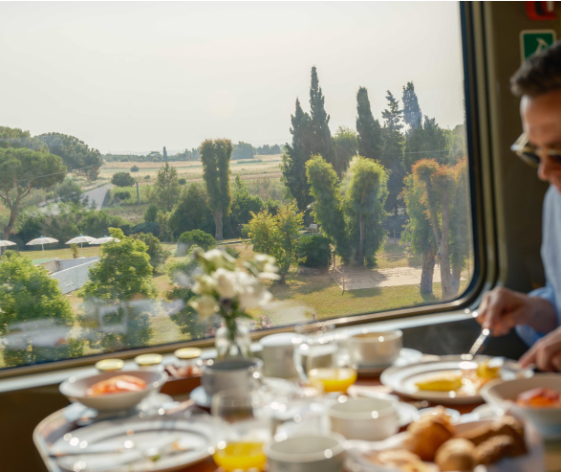
The second day begins slowly. Breakfast arrives with Italian precision. Strong espresso, fresh pastries, and simplicity handled properly.
Then comes one of the most distinctive moments of the journey. The train is decoupled and transferred onto a ferry to cross the Strait of Messina. Remaining inside the train as it moves across open water alters your sense of scale entirely. The horizon opens, and for a brief moment, the journey exists between land and sea.
From there, the train continues into Sicily, arriving in Taormina. Positioned above the Ionian coast, Taormina is defined by its terraces, historic streets, and views that stretch toward Mount Etna.
The “Traditions in Bloom” experience moves between Taormina and the hilltop village of Castelmola. Castelmola feels quieter, its stone alleys and panoramic terraces offering a slower, more intimate perspective of Sicily. In Taormina, the experience becomes more hands-on through a pastry atelier focused on the cannolo Siciliano. The process is precise, the ingredients simple, the result deeply tied to local identity.
For those continuing further, the Mount Etna excursion introduces a completely different landscape. Travelling by Jeep across volcanic terrain, guided by a volcanologist, you move through ancient craters, ash fields, and mineral-rich ground that feels almost otherworldly. The day often concludes at a local wine estate, where volcanic soil shapes both the wines and the cuisine.
The final stretch leads into Palermo. The question here is: how does a train cross water? This route is so special because of the experience. At Villa San Giovanni, La Dolce Vita Orient Express reaches the edge of mainland Italy, pauses, and is gently split and guided onto a ferry for the crossing over the Strait of Messina. It is a rare, almost dreamlike piece of travel theatre: polished carriages, rails and all, floating between Calabria and Sicily. We leave our cabin to find ourselves in a cruise experience crossing the water with a huge arancino a cono and an espresso in hand as we cross towards Palermo.
In Palermo, the pace changes again. Markets spill into the streets, historic architecture sits alongside everyday life, and the city carries a layered, complex rhythm that feels entirely its own.
The Real Luxury
By the time you reach Palermo, the difference becomes clear.
It is not just the level of comfort. It is the way the journey has been experienced. You have seen Italy change in real time. You have eaten in a way that reflects where you are. You have stepped into places with context rather than passing through them.
Most travel prioritises speed. This journey prioritises presence.
It would be easy to describe La Dolce Vita Orient Express as luxurious. That would also be the least interesting thing about it. What it offers instead is a way of travelling that feels considered from beginning to end. One where time is not something to manage but something you are finally allowed to enjoy. You notice more. The details, the transitions, the moments that usually disappear.
And once you experience travel like that, it becomes very difficult to accept anything less.
To discover more, visit La Dolce Vita Orient Express
View this post on Instagram
All Images Courtesy of La Dolce Vita Orient Express.