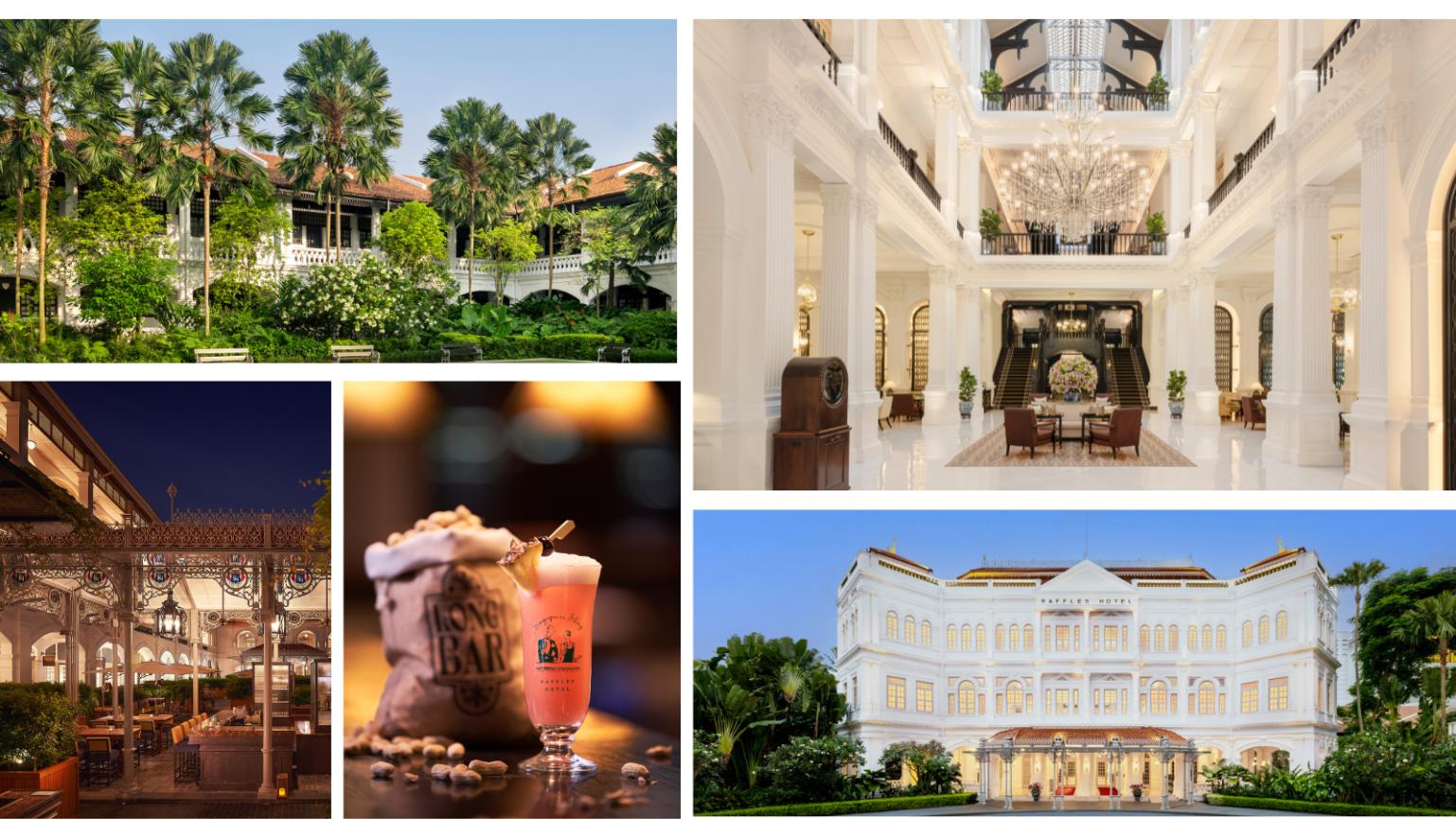
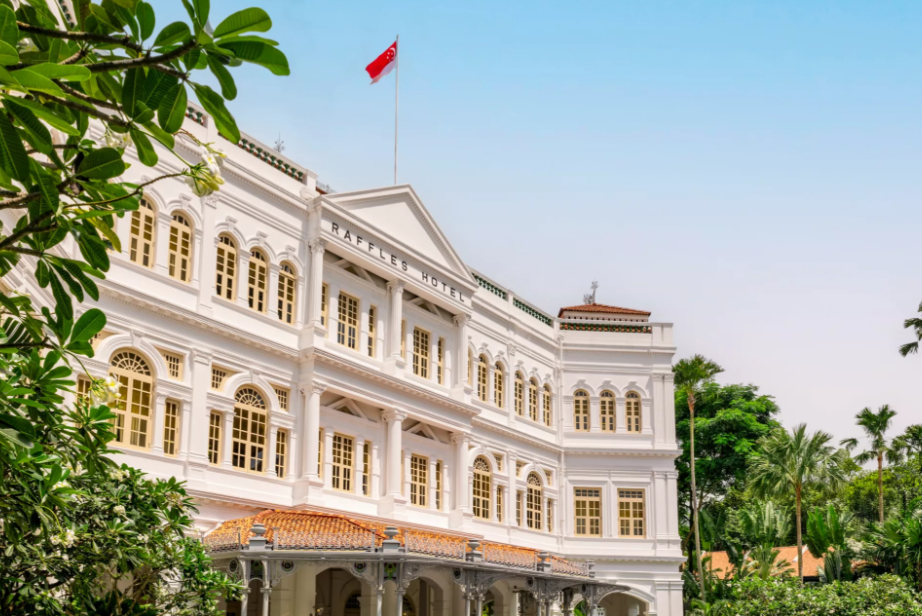
Turning off Beach Road into the deep gravel drive of Raffles Singapore feels like moving from a video game into a novel. Outside: steel, glass, screens glowing for attention. Inside: ceiling fans circle with lazy authority. Light takes its time crossing the floor. Ice clinks in glasses carried by people who learned long ago that haste is vulgar. You haven’t arrived at a hotel. You have walked into a sentence begun in 1887 by men who expected the world to fall in line behind them.
Named for Sir Stamford Raffles, the figure who dragged this island from mud into maps, the house drew fast-living travellers with a taste for the exotic and the self-invented. Staying here became a rite of passage for the sort of person who’d cross oceans to sip pineapple juice while imagining themselves a pioneer. The doormen in their white jackets and turbans have welcomed heads of government, actors and accidental millionaires without blinking. Their presence alone can turn a beige traveller into someone who believes they belong here.
The Sarkies Brothers opened Raffles as a ten-room bungalow facing the beach, which then lay almost where the road does now. Singapore was still a humid knot of commerce. Chinese workers built the new world one brick at a time while Europeans wilted through their collars and congratulated themselves for surviving the climate. Orchard Road smelt of nutmeg. The Padang was where authority practised its walk.
By the 1890s, Raffles had electric lights, mechanical fans and an international register filled with planters, traders, missionaries, drifters and opportunists. Kipling inspected. Maugham stayed and wrote. He declared: ‘Raffles stands for all the fables of the exotic East.’ He wasn’t wrong, though he edited out the sweat.
The myths are half true. Yes, a tiger from a travelling circus crept into the undercroft of the Bar & Billiard Room in 1902 and met its end there. Stories of duels in the garden or contraband hidden under silver domes are delightful lies, kept alive by guests who never let facts spoil a good night out.
Sling
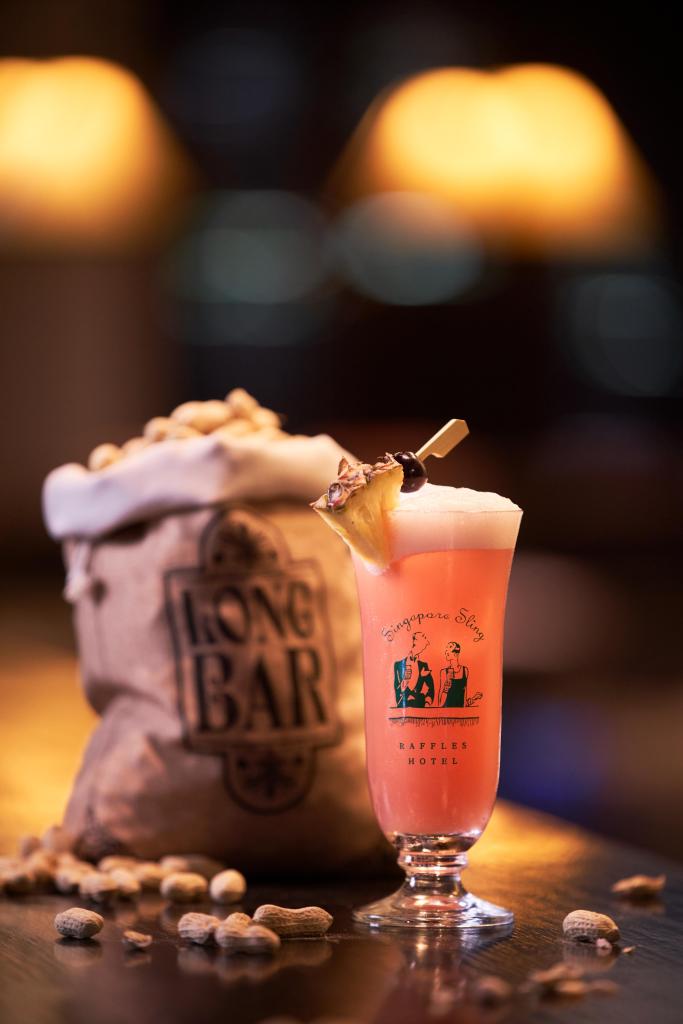
The Singapore Sling appeared in 1915 thanks to Ngiam Tong Boon, who produced an answer to a silent question: how to serve women something strong when convention demanded fruit juice. The pink colour did the work. Gin, cherry brandy, Bénédictine, pineapple, lime, grenadine: an ambush disguised as refreshment. At the Long Bar tourists shell peanuts and strew the husks like a ritual they don’t fully understand. Every crunch underfoot feels like a postcard from a version of empire nobody can quite explain yet refuses to retire.
The drink travelled. You can find versions of it in Paris, Phnom Penh, Dubai and of course London, though the original still holds court here, under rattan fans and the tropical pantomime the hotel performs with such conviction you forgive it immediately.
During the Japanese occupation, Raffles became Syonan Ryokan and endured its hardest years. When the British returned, they found it bruised but upright. By 1947 it had resumed service as if the war had been a particularly long afternoon storm.
Contemporary Singapore is a vertical spreadsheet. Towers bark their names into the skyline. Everything has a metric, a score, a target. Yet Raffles sits among the glass like an older relation who refuses to be rushed. Marina Bay gleams with engineered precision. Inside Raffles, time rearranges itself in your favour.
There are no rooms here, only suites of varying ambition: six studio suites, then state room suites, courtyard suites, Palm Court suites, personality suites, residence suites, promenade suites, four grand hotel suites and two presidential sanctuaries at the top, each around 260 square metres. Ceilings stretch so far above you that the air seems to stand to attention. Verandas catch the heat and give it back gently at dusk. Bathrooms are all marble and silver. Double vanities. Tubs which could soften the edges of almost anything, drawn for you.
A Raffles butler works round the clock with the calm certainty of someone who knows exactly how you travel and where you tend to lose things. Suitcases are sorted, folded, refreshed. A fruit tray appears, as do local tomatoes. Singapore Sling scented tea arrives before you realise you need it. Digital newspapers and magazines lie ready on the bedside tablet. A pillow menu lurks nearby.
Families move through with ease. A pram glides over the tiles as smoothly as a steamer trunk once did. Toys, games, warm bottles, babysitters: all arranged with the same unfussy grace which made Raffles famous.
The Writer’s Bar was reshaped in the 2019 restoration. Brass, leather, an old typewriter staring from the corner as if waiting for someone to misbehave. Drinks here are stories with ice: the ‘100 Year Journey’, the ‘Jungle Bird’, and ‘Blithe Spirit’, each mixed with the kind of precision which suggests the bartender has seen too many writers at 2 am, including a thirsty Hemingway, and now trusts only recipes.
Above the suites, a swimming pool turns the city into a reflection. The spa persuades your shoulders to drop. The fitness centre moves at its own agreeable tempo, treadmills pointed towards palms and white columns instead of adverts.
Campus of consumption
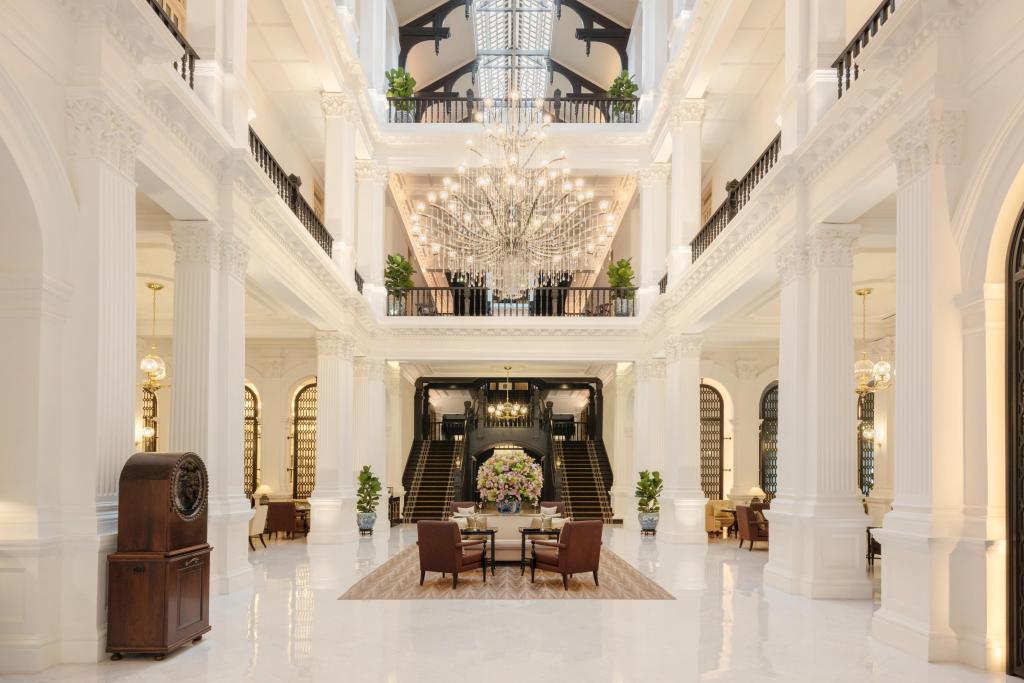
Raffles is not merely a hotel. It is a campus of consumption where restaurants line up like an edible exhibition. 藝 yì by Jereme Leung delivers modern Chinese dishes shaped with memory rather than nostalgia: clams alongside a cucumber chiselled into the shape of a snake, neat dumplings aligned like characters on a scroll, and Sichuan-scented sea cucumbers. Butcher’s Block brings the drama of fire to whole cuts of meat and big eye tuna. Tiffin Room, unchanged in spirit since 1892, carries North Indian dishes in gleaming copper tins, stacked tall. The wine list stretches from Kent to Ningxia. Afternoon tea in the Grand Lobby unfolds under chandeliers glitteringly vast. The Courtyard serves satay under frangipani.
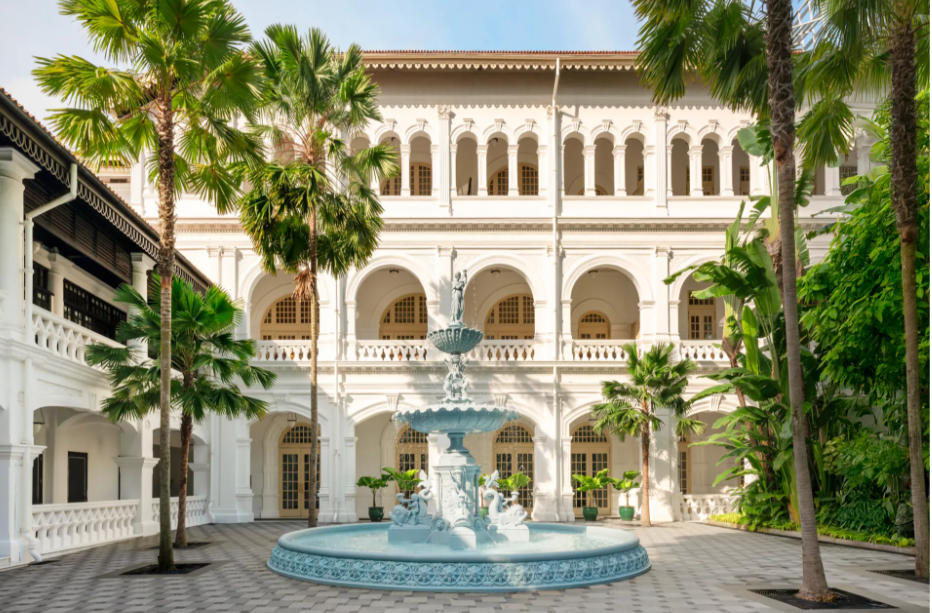
The grounds amount to nearly half the property: Palm Court, Palm Garden, Fern Court, Raffles Square, Palm Square, and the verdant Lawn. A map of lush green stitched through a labyrinth of white columns and tiled walkways. Beyond that lies the Arcade: over forty shops and ateliers including tailors, watch experts, galleries, a whisky shop, and quiet corners selling things you didn’t know you needed until you saw them.
The Boutique is the final coaxed smile: heritage teas, monogrammed stationery, leather-bound journals, and the hotel’s pale fragrance with its notes of bergamot and polished wood. It avoids all the usual tourist clutter.
The 2019 renovation by Aedas and Champalimaud strengthened the bones of the place without scarring it. Soundproofing improved. Air conditioning gained muscle. A Louis Vuitton store was tucked in without breaking the rhythm. Raffles emerged brighter and steadier, guided today by its managing director, Christian Westbeld, who keeps the whole contraption running with a watchful steadiness bordering on art.
Singapore has national flowers, national dishes, and national slogans. But Raffles is its national dream.
This isn’t nostalgia; this is continuity. A reminder that elegance does not demand noise, that unrushed moments still have purpose, and that a pink drink, a white jacket and a courtyard at dusk can outlast any skyscraper.
The Singapore Sling waits. Cold as marble. Sweet as recollection. Pink as permission.
For more information, visit Raffles Singapore.
Ver esta publicación en Instagram
All Images Courtesy of Michael Gartenlaub.